![[object Object]](https://cdn.sanity.io/images/yz4v1m0i/production/3c2ceffdd9e5617da853f9e0c40c29afcd4cac70-2000x2000.png?w=48&h=48&fm=webp&fit=min)


Ethereum often makes headlines as the world’s second-largest cryptocurrency, but thinking of it as just another coin misses the bigger picture. Ethereum is the digital backbone of a new kind of internet, one where people can lend, borrow, trade, and create all without relying on banks or tech giants.
From powering decentralised finance (DeFi) to enabling the rise of NFTs and smart contracts, Ethereum is the engine room of Web3 innovation. In this beginner's Ethereum guide, we’ll walk you through what Ethereum is, why it matters in 2025, how it works, and how everyday Australians can access it safely and easily via trusted platforms like BTC Markets.
What is Ethereum?
So, what is Ethereum? When we consider Ethereum, it's important to differentiate between Ethereum and Ether.
Ethereum refers to the decentralised, open-source blockchain network itself. Think of it as a global, distributed computer not owned or controlled by any single company or government.
Ether (ETH) is the native cryptocurrency of the Ethereum network. ETH is used to pay for computations carried out on the Ethereum Virtual Machine (EVM) and transaction fees (known as gas) on the network, and it can also be bought, sold, and held as a store of value.
Unlike Bitcoin, which was primarily designed as a peer-to-peer electronic cash system and as a store of value, Ethereum's main purpose is to be a platform for building and running smart contracts and decentralised applications (dApps). These are applications and automated agreements that operate on the blockchain without needing intermediaries like banks or traditional servers. This programmability of digital and financial assets is Ethereum's core innovation and underpins major trends in the digital asset ecosystem:
- Web3: Ethereum provides the infrastructure for Web3, a vision of the next generation of the internet built on decentralised technologies, where users have more control over their data and online interactions.
- DeFi (Decentralised Finance): Ethereum hosts a vast ecosystem of DeFi applications that offer financial services like lending, borrowing, trading, and insurance without relying on traditional financial institutions as intermediaries
- NFTs (Non-Fungible Tokens): Ethereum was the birthplace of the NFT standard (ERC-721), enabling the creation of unique ownership of digital files. This also enables the creation, ownership, and trading of unique digital assets, including art, collectibles, virtual land, and in-game items.
Essentially, Ethereum acts as the underlying technology, the rails, upon which many other popular crypto innovations are built. Understanding Ethereum is, therefore, key to understanding much of the broader digital asset landscape.
How did Ethereum get started?
The story of Ethereum began with Vitalik Buterin, a young Canadian programmer who was involved with Bitcoin in its early days. Buterin believed that blockchain technology had potential far beyond just being a digital currency or a store of value. He envisioned a more flexible platform with a powerful scripting language capable of supporting a wider variety of applications.
In late 2013, Buterin published the Ethereum whitepaper, outlining his vision. He was soon joined by a group of co-founders, including Gavin Wood, Charles Hoskinson, Anthony Di Iorio, and Joseph Lubin. To fund the platform's development, the Ethereum team launched a crowdsale in 2014, selling Ether (ETH) to the public in exchange for Bitcoin, raising over $18 million. The Ethereum crowdsale is often considered the first major Initial Coin Offering (ICO).
After extensive development, the Ethereum network officially went live on July 30, 2015, with its first version, Frontier. This launch was a landmark, marking blockchain's transition from a currency-focused technology to a versatile platform for decentralised applications, setting the stage for future innovations in DeFi and NFTs.
How does Ethereum work?
Understanding Ethereum's functionality requires grasping a few key concepts:
- The Blockchain: Like Bitcoin, Ethereum uses blockchain technology - a distributed digital ledger shared across thousands of computers, called nodes, worldwide. This ledger records all transactions and smart contract interactions permanently. New blocks containing batches of transactions are added to the blockchain roughly every 12 seconds.
- Proof-of-Stake (PoS) Consensus: Ethereum initially used Proof-of-Work (PoW) mining, the same mechanism used in traditional Bitcoin mining. However, in September 2022, it transitioned to Proof-of-Stake (PoS) through a major upgrade known as the Merge. Instead of miners using computational power, PoS relies on validators. To become a validator, users must stake at least 32 ETH (worth around US$20,000 at the time). Validators are randomly selected to propose new blocks and confirm transactions. In return, they earn ETH rewards. If a validator acts maliciously, a portion of their staked ETH is burned as a penalty. PoS is significantly more energy-efficient than PoW and allows ETH holders to potentially earn rewards by staking.
- Ethereum Virtual Machine (EVM): At the heart of the Ethereum network is the EVM - a piece of software that runs on every Ethereum node. It acts as a decentralised world computer. Its role is to process and execute smart contract code exactly as written, ensuring all nodes arrive at the same result and agree on the network's state. The EVM is designed to handle complex computations, making Ethereum highly programmable.
- Smart Contracts: These are programs stored on the blockchain that automatically execute predefined actions when specific conditions are met. Written in languages like Solidity, they operate an if-then logic and enable the creation of decentralised Applications by automating agreements without centralised intermediaries.
- Gas Fees: Every operation on Ethereum (sending ETH, interacting with a dApp, etc.) requires computational resources. Users pay a transaction fee called gas in ETH to compensate validators for providing and securing the network. The total fee depends on the computational complexity (gas limit) and network congestion (gas price). When the network gets busy, Gas fees can become very high, especially during network congestion. This has led to the development of scaling solutions, including:
- Layer 2 rollups
- Sidechains
- Sharding upgrades
- With a recent upgrade of the Ethereum chain, a portion of the gas fee (the base fee) is burned (i.e. made permanently unusable and removed from circulation).
Why is Ethereum valuable?
Ethereum's value stems from a combination of factors:
- Utility of Ether (ETH): ETH has intrinsic utility. It's essential for paying gas fees, used for staking in the PoS system (allowing holders to earn rewards), and is the primary collateral in Ethereum's vast DeFi ecosystem. This built-in demand gives ETH fundamental value.
- Platform for Innovation: Ethereum's programmability makes it a powerful platform for creating new types of applications and financial instruments, as seen with Decentralised Finance (DeFi) and NFTs. It serves as a core settlement layer for new digital economies.
- Network Effects: Ethereum benefits from the network effect, where a platform becomes more valuable to people as they use it. It boasts the largest developer community, user base, and the most capital locked in DeFi and the NFT market. This creates a feedback loop, where more developers attract more users and capital, which attracts more developers, solidifying Ethereum's position.
- Layer 2 Scaling and Value: A Layer 2 is a blockchain built on top of Ethereum to improve speed and reduce costs. It processes transactions off the main Ethereum chain (Layer 1) and settles them later, allowing users to interact faster and more cheaply while still benefiting from Ethereum’s security. Layer 2 solutions (L2s) are crucial for Ethereum’s ongoing scalability. By moving transactions off the main chain, L2s might reduce gas fees collected on Layer 1. However, the strategy is that by enabling cheaper, faster transactions, L2s will bring vastly more users and activity to the Ethereum ecosystem, ultimately increasing demand for ETH for security (staking), collateral, and settlement.
The Role of Ethereum in the Global Economy
Ethereum is increasingly playing a significant role beyond the crypto space:
- Alternative Financial System (DeFi): DeFi applications offer services like lending, borrowing, and decentralised exchanges, often with greater transparency and accessibility than traditional finance.
- Growing Institutional Adoption: Major financial institutions (e.g., BlackRock, JPMorgan) are exploring or using Ethereum and its L2s for applications like payments and tokenised assets. The approval of Ethereum Exchange Traded Funds (ETFs) in various jurisdictions provides regulated investment vehicles. The tokenisation of Real-World Assets (RWAs), representing assets like bonds or real estate as tokens, is another major area, with Ethereum as the leading platform.
- Infrastructure for the Digital Economy (Web3 & DAOs): Ethereum supports decentralised identity and blockchain-based gaming. It also enables Decentralised Autonomous Organisations (DAOs) - online communities governed by code and token-holder voting, offering new models for collective decision-making.
Ethereum is thus becoming a crucial layer where traditional finance intersects with decentralised systems and digital ownership.
Ethereum vs. traditional currencies
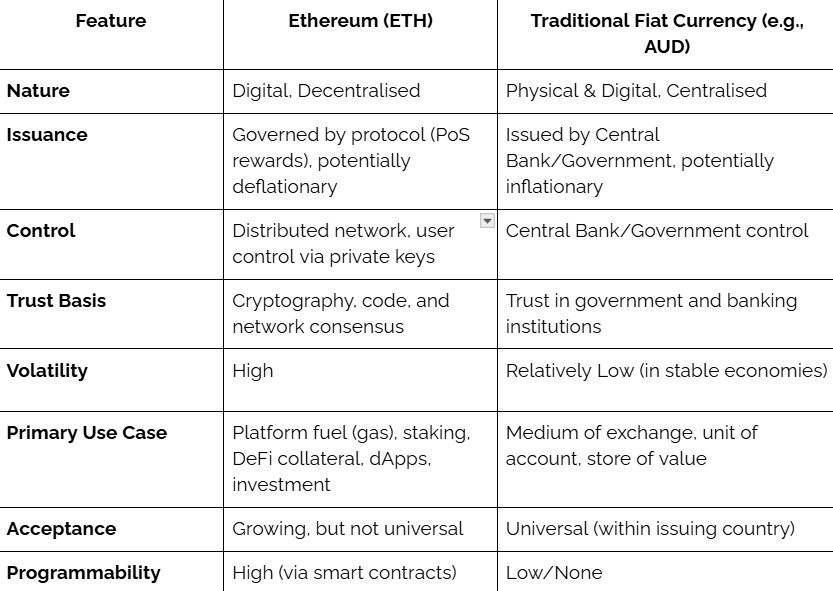
Comparing ETH to traditional fiat currencies like the Australian Dollar (AUD) highlights fundamental differences: This comparison shows a trade-off: traditional currencies offer stability and universal acceptance; Ethereum offers decentralisation, programmability, and innovation potential, but with higher volatility.
Ethereum vs. other cryptocurrencies
- Ethereum vs. Bitcoin (BTC): Bitcoin is generally accepted as being digital gold - a secure store of value and medium of exchange. Ethereum aims to be a decentralised world computer - a platform for building applications. This difference is reflected in their technology, consensus mechanisms, and supply dynamics.
- Ethereum vs. Other Smart Contract Platforms: Numerous platforms (e.g., Solana, Cardano) have emerged, often aiming for higher transaction speeds and lower fees on their base layer. However, Ethereum maintains significant advantages:
- Dominance: Largest by market capitalisation, value in DeFi (Total Value Locked), number of dApps, and active developer community.
- Network Effects: Its established ecosystem creates powerful advantages.
- Decentralisation and Security: Ethereum's development prioritises these, building trust.
- EVM Standard: The Ethereum Virtual Machine (EVM) is a de facto standard, with many chains adopting EVM compatibility.
- Layer 2 Strategy: Ethereum scales via L2 solutions, which handle transactions cheaply and quickly while using Ethereum's mainnet security for settlement. This modular approach allows scaling without compromising core principles.
While competitive, Ethereum's ecosystem and strategic focus on L2 scaling solidify its leading position.
How to buy Ethereum on BTC Markets in 2025
BTC Markets provides a secure and regulated platform for Australians to buy Ethereum (ETH).
- Step 1: Create an Account and Complete KYC Verification
- Sign Up: Visit BTC Markets or download the mobile app. Click Sign Up.
- Verify Your Identity (KYC).
- Secure Your Account (2FA): Enable Two-Factor Authentication immediately using an authenticator app (like Google Authenticator).
- Step 2: Deposit AUD into Your BTC Markets Account via:
- Bank Transfer.
- PayID.
- Card Deposit.
- Step 3: Select Ethereum and Place Your Order
- Navigate to Trading: Log in and go to the Trade or Buy/Sell section.
- Select Market: Choose the ETH/AUD trading pair.
- Choose Order Type:
- Market Order: Buys ETH immediately at the best currently available price.
- Limit Order: Sets a specific maximum price you're willing to pay per ETH. The order executes only if the market price reaches your limit or lower.
- Overview of Fees and Payment Methods
- Deposit Methods: Bank Transfer (1-3 days, free), PayID (Instant, free), Card Deposit (Instant, fees apply).
- Trading Fees (ETH/AUD): A tiered system based on your 30-day AUD trading volume. Higher volume means lower fees.
- Withdrawal Fees: Withdrawing AUD to your bank is free. Withdrawing ETH to an external wallet incurs a fee.
How to sell your Ethereum in 2025
Selling your Ethereum for AUD on BTC Markets is the reverse of buying:
- Log In: Access your BTC Markets account.
- Go to Trading/Sell: Navigate to the trading interface and select the ETH/AUD market.
- Enter Sell Details: Choose your order type (Market or Limit). Enter the amount of ETH you wish to sell.
- Receive AUD: Once the order executes, AUD will be credited to your BTC Markets account.
- Withdraw AUD: Initiate a withdrawal of AUD funds to your linked Australian bank account.
Storing Ethereum safely
Securing your ETH is crucial. You have several options:
- Hot Wallets: Connected to the internet (e.g., wallet within BTC Markets, mobile apps like MetaMask).
- Pros: Convenient for quick access, trading.
- Cons: More vulnerable to online threats (hacking, malware).
- Cold Wallets: Store your private keys completely offline.
- Pros: Significantly higher security, ideal for larger amounts or long-term storage.
- Cons: Less convenient for frequent transactions, requires physical management.
- Types:
- Hardware Wallets: Physical devices (e.g., Ledger, Trezor) that store private keys offline. Highly recommended for long-term storage.
- Paper Wallets: Printing keys on paper. Secure if stored safely, but fragile.
- Storing Ethereum Securely on BTC Markets: BTC Markets provides a custodial wallet service to manage ETH storage:
- A hybrid system of hot and cold wallets (majority in cold storage ).
- Two-Factor Authentication (2FA) for user accounts.
- Compliance with AUSTRAC KYC/AML regulations.
- Regular reconciliations and ISO 27001 certification for information security.
- A proven track record since 2013. While BTC Markets offers a secure environment, for maximum control, especially with significant long-term holdings, consider a personal hardware wallet.
The future of Ethereum in 2025 and beyond
Ethereum continues to evolve, focusing on scalability, regulation, and new use cases, while facing growing competition.
- Scalability through Layer 2s and Upgrades: L2 solutions are regularly being added to process transactions off the main Ethereum chain for speed and cost-efficiency, then settle on Layer 1. Ethereum upgrades support this:
- Dencun Upgrade (March 2024): Introduced "proto-danksharding" ("blobs"), significantly reducing L2 transaction fees.
- Pectra Upgrade: designed to improve staking efficiency, enhance user experience via Account Abstraction, and further increase blob capacity for L2s.
- Potential Growth Areas:
- DeFi: Continued innovation, integration with traditional finance (TradFi) through tokenised Real-World Assets (RWAs).
- NFTs: Evolving beyond collectibles to "NFT 2.0," focusing on utility, interoperability, and AI-generated NFTs.
- DAOs: Wider adoption for governing online communities and protocols.
- Web3 Gaming: Growth in blockchain gaming with true player ownership of in-game assets (NFTs) on L2s.
- Global Settlement Layer: Solidifying its role for settling transactions of various digital and tokenised assets.
- Institutional and Regulatory Landscape: Continued institutional adoption is likely, facilitated by ETFs and RWA tokenisation. Regulatory clarity remains crucial; a favourable environment could boost adoption, while uncertainty could pose challenges.
Ethereum's future success hinges on effective L2 scaling, sustained innovation, and navigating the regulatory sphere.
Buy Ethereum with BTC Markets
Ethereum represents a significant innovation, offering much more than just a currency. It's a platform driving advancements in finance, digital ownership, and the internet.
If you're ready to begin your journey with Ethereum, BTC Markets offers a secure, reliable, and user-friendly platform designed for Australians. As a locally owned and operated exchange established in 2013, BTC Markets prioritises security, compliance with Australian regulations (AUSTRAC registered), and provides expert local support.
Get BTC Markets content delivered
Keep up to date with the latest from BTC Markets. Unsubscribe anytime.SubscribeFind out the latest crypto news
BTC Markets’ new platform is live and out of beta