![[object Object]](https://cdn.sanity.io/images/yz4v1m0i/production/3c2ceffdd9e5617da853f9e0c40c29afcd4cac70-2000x2000.png?w=48&h=48&fm=webp&fit=min)


From ancient vaults to digital wallets, gold and Bitcoin represent two ends of the value spectrum. Both have been used to preserve wealth and navigate economic uncertainty. How do they really compare? In this guide, we unpack the differences between Bitcoin and gold to help you better understand their roles in the modern financial world.
Check the latest Bitcoin price on BTC Markets
A brief history of Bitcoin and gold
Across millennia, civilisations have turned to gold as a store of value. From ancient coins to modern bullion, gold has symbolised stability and trust. Thanks to its physical properties and scarcity, gold became a dependable asset long before central banking emerged.
In 2009, Bitcoin made its debut as the world’s first decentralised digital asset. Behind it was the mysterious and anonymous figure known as Satoshi Nakamoto, who proposed a new kind of peer-to-peer money, one that relied on code instead of needing trust between banks and financial institutions.
Today, both assets are often considered ways to protect wealth from inflation and monetary instability, even though they operate in fundamentally different ways.
How Bitcoin and gold differ
Let’s look at how the two differ across a few important areas.
Starting with scarcity, gold’s supply grows slowly over time through capital-intensive mining. Unlike Bitcoin, whose supply is absolutely capped by the code that powers the Bitcoin network at 21 million coins.
Now, take divisibility: slicing or melting gold isn’t exactly practical. Bitcoin, being digital, splits effortlessly into tiny units called "satoshis." Each Satoshi is 1 hundred-millionth of a Bitcoin, making it easy to send and spend Bitcoin in very small amounts.
When it comes to portability, gold is heavy and cumbersome to move. Moving it across borders takes time, money, and heavy security. Bitcoin, on the other hand, moves digitally across the globe in minutes with just a smartphone and internet access.
Security is another big one. Gold needs safes, vaults, and ongoing physical protection. Bitcoin is protected by cryptography and a decentralised network, giving users control over their assets without needing a trusted third party. Ironically, many high-net-worth individuals are increasingly storing their Bitcoin in cold hardware wallets. These wallets are kept offline and often placed in safety deposit boxes in the very banks that Bitcoin technology is disrupting.
And then there's liquidity. Both assets are widely traded, but Bitcoin doesn’t clock out. It trades 24/7, while gold markets operate within set hours and structures.
The role of Bitcoin and gold in the modern economy
For centuries, people have turned to gold to protect what they’ve earned. It's a long-time favourite of central banks and remains a go-to during economic downturns. Gold once underpinned the US dollar under the gold standard, where every dollar issued was backed by gold. This gold standard system was removed by President Nixon in 1971.
Bitcoin, often called “digital gold”, offers a decentralised option for value storage. No government or major corporation controls the Bitcoin network. Instead, it is operated by the Bitcoin community, comprising primarily of Bitcoin miners. Its independence from governments and traditional financial systems, together with its programmability, gives it a unique place in the digital economy.
While both may react to economic uncertainty, they do so in different ways, and with different user bases in mind.
Price volatility: How Bitcoin and gold compare
Gold tends to hold steady, with its price usually moving in response to major geopolitical or economic shifts. That long, consistent track record gives many investors a sense of predictability and reassurance when considering gold.
Bitcoin’s wild price swings are no secret. While greater adoption might one day settle the ride, for now, volatility is just part of the experience. The gold vs. Bitcoin debate often hinges on whether that volatility is viewed as a risk or an opportunity.
How to buy and trade Bitcoin with BTC Markets
For Australians interested in Bitcoin, BTC Markets provides a secure platform to buy, sell, and trade. Here's how to get started:
- Create an account: Sign up and verify your identity in line with Australian regulations.
- Deposit AUD: You can easily fund your account with Australian dollars.
- Buy or trade Bitcoin: Use BTC Markets’ interface to place orders and monitor market trends.
- Store your Bitcoin: You can choose to store it securely on-platform or move it to a personal wallet.
BTC Markets is Australian based, fully regulated, and committed to offering users a secure trading experience.
Get BTC Markets content delivered
Keep up to date with the latest from BTC Markets. Unsubscribe anytime.SubscribeFind out the latest crypto news
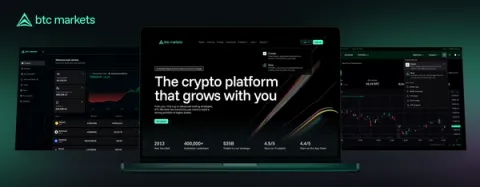
BTC Markets’ new platform is live and out of beta