

Welcome to your BTC Markets VIP Desk briefing.
Time to read: ~6 minutes
The week in 60 seconds
- Energy: WTI crude topped US$100 (A$144), gaining 10% over the week as Iranian attacks intensified around the Strait of Hormuz.
- Macro: US inflation reached 3.7%, reinforcing expectations of a December Fed rate hike.
- Equities: Weakness in semiconductor stocks pushed the Nasdaq to its worst weekly performance since June.
- Crypto: Bitcoin briefly fell below US$80,000 (A$115,200) before recovering to around US$81,500 (A$117,360), as ETF outflows persisted.
- Ahead: With no major Fed commentary scheduled this week, earnings from Meta and Tesla take on greater significance.
Intro
Oil dominated markets last week. Crude prices climbed back above US$100 (A$144), while a hotter US inflation reading and a sharp sell-off in technology stocks added to investor caution. Bitcoin briefly fell below US$80,000 (A$115,200) before recovering, although ETF outflows continued to weigh on sentiment. This edition examines the implications of higher oil prices for interest rates, the selling pressure facing Ether funds, and the key developments to watch during a quieter week for the Fed.
Significant events
Three pressures, one direction
Rising oil prices, persistent inflation and weakness in technology stocks weighed on risk assets, although Bitcoin recorded smaller losses than the Nasdaq.
Oil returns to triple digits
WTI crude settled at US$101.41 (A$146.03), gaining 10.4% over the week, while Brent reached US$110 (A$158.40) for the first time since May. Escalating Iranian attacks around the Strait of Hormuz renewed concerns over global oil supplies, reversing the relief provided by the G7's earlier reserve release. With geopolitical tensions unresolved, further disruptions could keep energy prices elevated and add to inflationary pressures.
Inflation keeps the Fed tightening
US headline inflation reached 3.7%, while producer prices recorded their largest increase in four and a half years. Expectations of an October Fed rate hike briefly climbed above 40%, reversing the decline that followed September's weaker employment figures. Odds subsequently fell below 20% after Fed Chair Warsh declined to signal a decision ahead of the meeting. Markets now price a December rate hike at around 90%, keeping borrowing costs and their implications for Bitcoin firmly in focus.
Technology stocks lead market losses
Selling pressure across AI and semiconductor stocks pushed the Nasdaq down 4.5% for the week, while the Dow recorded modest gains. Bitcoin declined approximately 2.9%, outperforming the technology-heavy index despite continued weakness across risk assets. The divergence suggests that selling was concentrated in technology stocks, although a single week's performance provides limited evidence of a sustained change in Bitcoin's relationship with equities.
Sources: CNBC, EnergyNow, Reuters via CNBC, Associated Press, Investrade, CoinGecko
By the Numbers
The Week in Data
~70%: Share of pre-war crude oil exports continuing to pass through the Strait of Hormuz, indicating that shipments remain below previous levels.
Source: Kpler via CNBC
−11.41%: Weekly decline in US semiconductor stocks, reflecting the sharp sell-off across the technology sector.
Source: Portfolio Terminal
1.27 million BTC: Bitcoin held by US spot ETFs, despite approximately US$535 million (A$770.40 million) in net outflows during October.
Source: Crypto Briefing, Farside Investors
848,250 BTC: Strategy's total Bitcoin holdings, representing approximately 4% of circulating supply, following the addition of 3,199 BTC over the past 30 days.
Source: CoinGecko Treasuries
Market snapshot
Cooler greed, and leaning on bitcoin
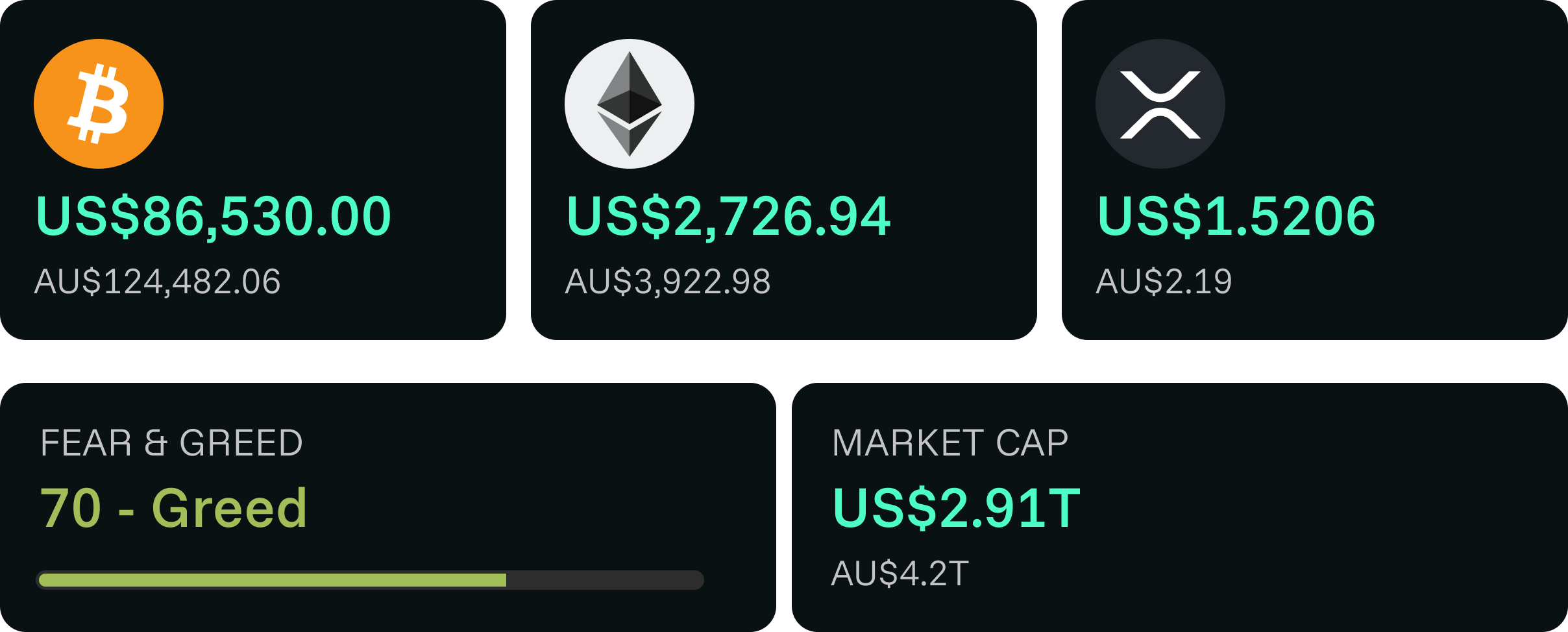
Market sentiment has cooled over the past two weeks. The Fear & Greed Index has fallen from 70 to 59, although it remains in Greed territory. Persistent inflation concerns, higher oil prices and ETF outflows have tempered investor appetite for risk.
Bitcoin fell 2.9% over the week, compared with a 4.7% decline in the broader crypto market. Bitcoin dominance has risen from 57.9% to approximately 60.7%, reflecting its relative resilience as smaller digital assets face greater selling pressure.
US spot Bitcoin ETFs recorded net outflows of approximately US$228 million (A$328.32 million) for the week. The withdrawals suggest institutional demand remains subdued despite Bitcoin's stronger performance relative to the broader market.
Sources: Alternative.me, CoinGecko, Farside Investors via crypto.news, Coinpedia
The Signal
Ether funds take the heavier hit
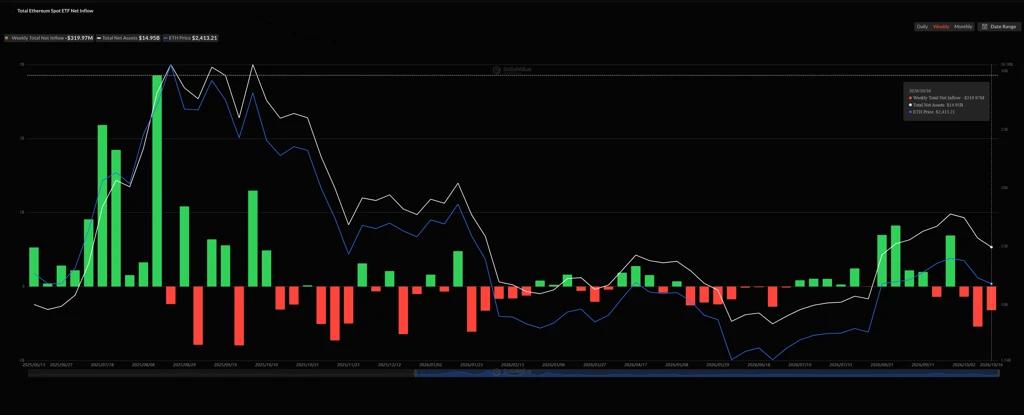
Ether ETFs recorded larger outflows than Bitcoin funds last week, led by withdrawals from BlackRock's ETHA.
Ethereum Spot ETF Net Flows
US spot Ether ETFs recorded approximately US$320 million (A$460.80 million) in net outflows last week, compared with US$228.4 million (A$328.90 million) from Bitcoin funds. BlackRock's ETHA accounted for roughly 93% of Ether ETF withdrawals, highlighting the concentration of selling pressure in the largest fund.
Source: Ethereum Spot ETF Dashboard: Charts of Total Net Inflow and Outflow, Price, Fees and News
Economic calendar
The week ahead
A lighter economic calendar puts corporate earnings, inflation concerns and key activity indicators in focus ahead of next week's Fed decision.
19 October: China Q3 GDP
China's third-quarter growth figures are expected to show an expansion of around 4%. The results will provide an indication of economic momentum and potential implications for commodity demand and the Australian dollar.
20 October: RBA Deputy Governor Andrew Hauser speaks
Hauser's remarks could offer further insight into the RBA's assessment of inflation risks, particularly as higher oil prices add pressure to household and business costs.
22 October: Meta and Tesla Q3 earnings
Quarterly results from Meta and Tesla will provide an early test of investor confidence in major technology companies following last week's semiconductor sell-off.
22 October: Australian flash PMI
Preliminary October manufacturing and services data will offer an early indication of domestic business activity amid elevated borrowing costs and rising energy prices.
22 October: US jobless claims
Weekly unemployment claims will provide another measure of US labour market conditions ahead of the Fed's October policy decision.
24 October: US flash PMIs and consumer sentiment
Preliminary October business activity figures and the final University of Michigan consumer sentiment reading will offer further insight into economic conditions and inflation expectations.
29-30 October: Fed decision and crypto options expiry
The Fed's next policy announcement and monthly crypto options expiry fall in the same week. Both events could influence market volatility as investors assess the outlook for interest rates and positioning across digital assets.
Sources: Newsquawk, BabyPips, Schwab, Investing Preview (Substack)
From the Desk
Priced off oil and the Fed
Crypto is taking its cues from oil and the Fed, and neither has eased.
Two weeks ago, we wrote that the price of money still rules. That remains true, but attention has turned from bond yields to oil. Rising energy prices have introduced another inflation risk that the Fed cannot easily control. That's a difficult backdrop for assets that depend on favourable liquidity conditions.
Even so, Bitcoin held up. It dipped below US$80,000 (A$115,200), recovered and recorded smaller losses than the Nasdaq and the broader crypto market. Rising dominance suggests investors are favouring Bitcoin's liquidity over smaller digital assets rather than leaving crypto altogether. That's caution rather than conviction, and sentiment could change quickly.
As the Fed enters its quiet period, markets will focus on other developments. Oil enters the week above US$100 (A$144) following reports of further tanker and missile attacks over the weekend. Meta and Tesla's earnings could help determine if the AI sell-off reflects concerns over valuations or spending. ETF flows will also provide an indication of institutional appetite for crypto.
For now, developments outside crypto continue to shape market conditions. The Fed's 29 October decision is the next major event to watch.
Question of the Week
Q: If Bitcoin is an inflation hedge, why did it fall during a week of higher inflation?
A: Over the long term, Bitcoin's fixed supply supports its appeal as an inflation hedge. In the short term, however, its price remains sensitive to interest rate expectations. Higher inflation increases the likelihood of further Fed rate hikes, making cash and bonds more attractive while raising the opportunity cost of holding non-yielding assets such as Bitcoin. Gold faced similar pressure last week, declining despite the hotter inflation figures.
Story of the week
Thirteen years of silence, broken in five seconds
Two Bitcoin wallets untouched since 2013 became active within seconds of each other on Saturday.
On Saturday, two Bitcoin addresses dating back to 2013 moved a combined 416.69 BTC, worth approximately US$34 million (A$48.96 million), in the same block. Similar transaction patterns suggest the wallets may belong to the same owner. The Bitcoin remained untouched for thirteen years, through three halvings, the launch of spot ETFs and multiple market cycles.
CoinGecko estimates that around a fifth of all Bitcoin may be permanently lost. Each dormant wallet that becomes active again offers a reminder that some early holders still retain access to their coins, even after more than a decade.
Sources: Bitcoin.com News, CoinGecko
Announcements

Australia FIX Conference 2026 puts tokenisation in focus
BTC Markets Chief Commercial Officer Paul Stonham will moderate a panel at the Australia FIX Conference 2026 on 22 October at The Fullerton Hotel Sydney. The discussion, “From Pilots to Market Infrastructure: Tokenisation Becomes Real,” will explore the progress of tokenisation in financial markets, its potential for institutional adoption and key considerations around custody, liquidity, interoperability, digital identity and regulation.
BTC Markets celebrates three finalist nominations at The DIGIs 2026
BTC Markets has been recognised in three categories at the 2026 Australian Digital Economy Awards (The DIGIs): Digital Currency Exchange of the Year, The Blockies Award for Blockchain & Digital Asset Excellence, and Emerging Leader of the Year (Under 35), recognising Anastasia Varlamova, People and Culture Manager. The winners will be announced in Sydney on 27 November.
Thank you for reading. Reach out anytime if you would like to discuss this week's content.

Disclaimer: The information provided on this page is issued by BTC Markets Pty Ltd (BTC Markets, we, us, our). The information is general only and is not intended to constitute an opinion or recommendation with respect to its contents. Past performance is not a reliable indicator of future performance. Any reference to past performance is intended to be for general illustrative purposes only. The information cannot be relied upon for any purposes and is not intended to be a substitute for professional advice.
The information does not purport to be complete, accurate or contain all of the information that a person may require to make a decision. It may also contain forward looking statements, which are subject to known and unknown risks, uncertainties, and other factors. We recommend you obtain professional advice before making any decision with respect to the matters discussed in this document. To the maximum extent permitted by law, BTC Markets will have no liability for any loss or liability of any kind: (i) arising in respect of the information contained (or not contained) on this page; or (ii) arising from a person relying on any information or statement contained on this page. The information provided is only intended for recipients in Australia. This information cannot be reproduced without our prior written permission.
Get BTC Markets content delivered
Keep up to date with the latest from BTC Markets. Unsubscribe anytime.SubscribeFind out the latest crypto news

What institutional partners should take from Australia's tokenisation timeline