![[object Object]](https://cdn.sanity.io/images/yz4v1m0i/production/38f2c02224d5ea8d551881949e819f95a9952e46-3972x5243.jpg?rect=0,0,3972,3972&w=48&h=48&fm=webp&fit=min)


TLDR
- Over US$19.3B in leveraged positions erased, marking the largest liquidation in crypto history
- U.S. tariff threat on Chinese imports triggered a global cascade amid record leverage and thin liquidity
- Rare-earth tensions link AI fragility and geopolitical risk to wider market volatility
- Bitcoin plunged from US$122K to US$102K before rebounding above US$115K
- Traders brace for headline-driven swings ahead of Trump’s November 1 tariff deadline
Introduction
The cryptocurrency market experienced one of its sharpest corrections on record on Friday, 10 October. Roughly US$19.3B in leveraged positions were liquidated within hours, affecting more than 1.6 million traders. Bitcoin plunged from around US$122K to lows near US$108K, marking the largest liquidation in crypto history. While the immediate spark was a 100% U.S. tariff threat on Chinese imports, the event exposed an overleveraged market sitting on record open interest and thin weekend liquidity.
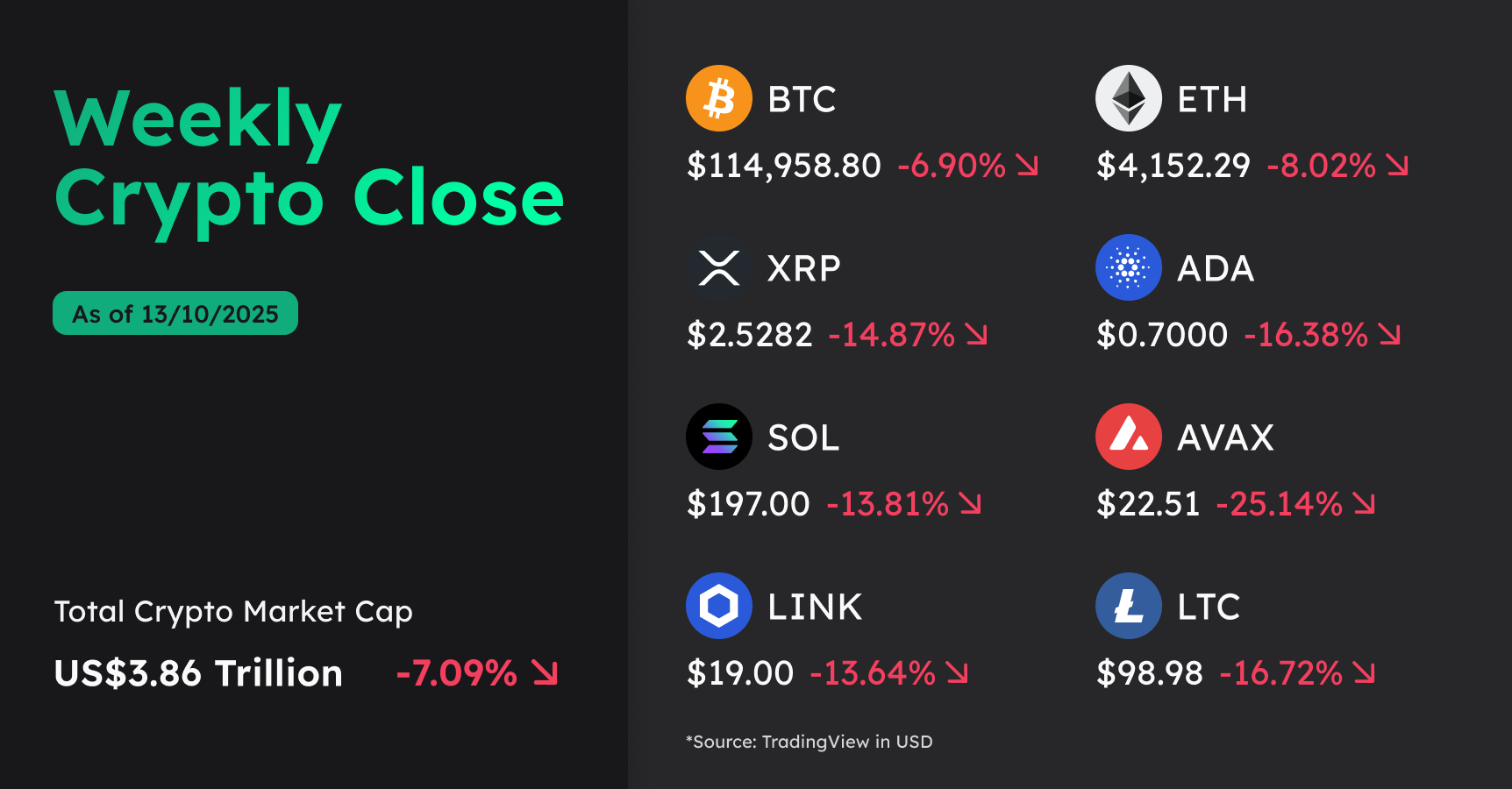
Weekly trading stats as of Monday, October 13th at 10:00 AM AEDT, based on data from TradingView in USD.
Check prices
Over US$19.3B in leveraged positions erased, marking the largest liquidation in crypto history
Global headlines in crypto have been dominated by the size and scope of the liquidations that happened globally on Friday evening as a result of escalating tensions between the US and China, which played out on social media. The events from Friday’s market have eclipsed any ongoing macroeconomic data.
The cryptocurrency market suffered one of its sharpest corrections on record on Friday, 10 October. Over US $19.3B in leveraged positions were liquidated within hours. More than 1.6 million traders were affected as Bitcoin briefly plunged from around US$122K to intraday lows near US$102K on some global exchanges, with most exchange lows hovering around US$108,000. This represents the largest liquidation event in crypto history. Bitcoin has subsequently shown some early signs of recovery, currently hovering around the US$115,000 - US$116,000 levels.
Check ETH
U.S. tariff threat on Chinese imports triggered a global cascade amid record leverage and thin liquidity
The immediate catalyst was a social-media post from President Trump announcing a 100% tariff on all Chinese imports. The announcement came less than 24 hours after Beijing introduced new export restrictions on rare-earth minerals, intensifying trade tensions between the world’s two largest economies. Before we complete our analysis of what happened, it is critical to understand the importance and relevance of rare earths in terms of AI and the geopolitical battles that are currently waging globally.
Check XRP
Rare-earth tensions link AI fragility and geopolitical risk to wider market volatility
Rare earths are the unsung heroes behind the hardware that powers AI, from data centre servers and cooling systems to high-performance chips. Their unique magnetic and optical properties enable the motors, sensors, and processors that drive today’s machine-learning workloads. A stable supply chain isn’t just helpful; it’s essential to scaling AI capacity without disruption.
Given the intense global race to dominate AI, now seen as a matter of strategic importance, any threat to that supply chain could have serious consequences. This is particularly true for US markets, where AI-related companies like Nvidia have been key drivers of equity market growth. With some analysts already warning of a potential AI bubble, anything that undermines confidence in the sector could trigger sharp reactions in markets that are already showing signs of fragility.
The VIX is often a major warning sign of things to come. The VIX (the ticker for the Chicago Board Options Exchange (CBOE) Volatility Index) jumped by 32% on the initial tariff threat earlier that morning. The VIX tracks the market’s expected volatility by using the prices of options within the main US equity markets - principally the S&P 500. The CBOE calculates this in real time. Because VIX tends to rise when investors get nervous, it is often called the “fear index” or “fear gauge”.
At the same time, Bitcoin had already eased from record highs above US$126,000 to around US$117,000 before the second, more forceful social media post by President Trump arrived. When the 100% tariff declaration hit, liquidity evaporated, triggering a cascading sell-off across global exchanges.
The mechanics of the liquidation: extreme leverage meets thin liquidity
In the weeks leading up to the event, open interest in Bitcoin derivatives had reached record highs (~US$94B). This is a warning sign of widespread leverage. The tariff shock struck late on a Friday, US -time, a period of reduced global liquidity, which caused an automated chain of forced liquidations as margin positions were unwound - i.e. those who had borrowed heavily to buy Bitcoin in the expectation of further higher price growth were liquidated as Bitcoin’s price fell dramatically.
At the same time, major global trading exchanges also reported intermittent outages, with order books freezing and stop-loss functions failing. Over the years in the crypto markets, these intermittent outages have occurred globally in extreme trading circumstances. BTC Markets thankfully did not experience such outages.
These technical issues magnified the sell-pressure, turning what began as a sharp correction into a full-scale liquidation cascade.
Blockchain analysts have also highlighted a large wallet on the derivatives platform Hyperliquid that entered short positions against BTC and ETH just minutes before the tariff announcement. The account reportedly realised gains of nearly US $200 million, fuelling calls within the industry for an investigation into potential insider activity. At this stage, however, the claims remain unproven.
The episode underscored how geopolitics can spill rapidly into markets and can turn based on a single social media post. China’s move to restrict rare-earth exports was viewed as a strategic challenge of AI ahead of the planned Trump–Xi meeting at the APEC summit later this month.
Trump’s tariff escalation appeared to be both politically timed and economically disruptive. Investors continue to assess whether these measures are a temporary negotiating tactic or the opening of a renewed trade confrontation. Time is expected to give us the appropriate signals.
Check SOL
OTC Desk
Experience seamless trading: Unlock personalised, secure, and efficient OTC crypto transactions.

When it comes to large-scale crypto transactions, trading over the counter (OTC) with us offers a streamlined, secure, and personalised experience that other exchanges simply can't match. Our OTC desk minimises slippage and ensures deep liquidity, so you can execute sizable trades without the worry.
With our expert traders by your side, we tailor each trade to meet your specific goals. We prioritise speed and compliance, meaning you can lock in optimal prices with the comfort of full regulatory assurance.
Book a call with your OTC expert today.
Bitcoin plunged from US$122K to US$102K before rebounding above US$115K
Despite the severity of the event, Bitcoin found support above the US$108K region and has since stabilised nearer US$115K - US$116K, a previous level of key support/resistance. Bitcoin dominance spiked to 63.5% during the market collapse and fell back to the current level of 59%. While the formal data for ETF inflows are not yet available (the crash happened outside traditional market trading hours) the spike in Bitcoin’s dominance suggests a significant rise in interest, which are expected to be reflected in very healthy ETF inflows, with the crash presenting an ideal buying opportunity for institutional investors.
Altcoins, however, remain under pressure. The overall market capitalisation of the cryptocurrency sector collapsed from ~$4.1T to $3.66T with red right across the altcoin space.
Future performance is likely to be narrative-driven, with themes such as AI and associated geopolitical narratives expected to shape any recoveries.
Check BTC
Traders brace for headline-driven swings ahead of Trump’s November 1 tariff deadline
The near-term outlook hinges on geopolitics.
Trump has set a 1 November deadline for tariff implementation, leaving room for negotiation before the 31 October APEC summit. In news today, Donald Trump hinted at a calmer tone, highlighting on his Truth Social account, "Don't worry about China, it will all be fine! Highly respected President Xi [Jinping] just had a bad moment. He doesn't want Depression for his country, and neither do I. The U.S.A. wants to help China, not hurt it!!!". The markets have reacted positively to this softer tone, although it remains to be seen how the overall US-China relationship will pan out.
If we can take any comfort from history, similar tariff threats have been rolled back once concessions are secured, but if tensions persist, risk assets, such as cryptocurrencies, could face prolonged volatility.
For now, the market appears to have had a historic leverage reset. Of course, only time will tell if this is anything more than that, but there remains concern over the uncertain implications on the AI market.
However, traders should brace headline-sensitive, highly volatile environment as macro and political forces continue to shape the crypto landscape.
Check AVAX
Stay up to date on the latest news in the digital asset space.
Sign up for free and join over 374,000 Australian traders who receive the BTC Markets weekly updates.
Google review
If you've had a great experience with BTC Markets, we'd love to hear from you! Leave us a review.
Feedback
If you have any feedback on our newsletter or want to request specific content, please submit a support ticket, and we will respond shortly.
Disclaimer: The information provided on this page is issued by BTC Markets Pty Ltd (BTC Markets, we, us, our). The information is general only and is not intended to constitute an opinion or recommendation with respect to its contents. Past performance is not a reliable indicator of future performance. Any reference to past performance is intended to be for general illustrative purposes only. The information cannot be relied upon for any purposes and is not intended to be a substitute for professional advice.
The information does not purport to be complete, accurate or contain all of the information that a person may require to make a decision. It may also contain forward looking statements, which are subject to known and unknown risks, uncertainties, and other factors. We recommend you obtain professional advice before making any decision with respect to the matters discussed in this document. To the maximum extent permitted by law, BTC Markets will have no liability for any loss or liability of any kind: (i) arising in respect of the information contained (or not contained) on this page; or (ii) arising from a person relying on any information or statement contained on this page. The information provided is only intended for recipients in Australia. This information cannot be reproduced without our prior written permission.
Get BTC Markets content delivered
Keep up to date with the latest from BTC Markets. Unsubscribe anytime.SubscribeFind out the latest crypto news