![[object Object]](https://cdn.sanity.io/images/yz4v1m0i/production/38f2c02224d5ea8d551881949e819f95a9952e46-3972x5243.jpg?rect=0,0,3972,3972&w=48&h=48&fm=webp&fit=min)

Sign up to our weekly newsletter
Stay informed on the latest market updates – subscribe to our weekly newsletter today.
Introduction
Over the past week, investors have had to wrestle with a flurry of contradictory economic signals. Inflation in the United States appeared to be cooling, raising hopes of a gentler policy stance from the Federal Reserve. But almost immediately, producer price data reminded everyone that cost pressures are still alive and kicking. For equities, that tension translated into profit-taking, particularly in technology stocks that had enjoyed a strong run on the back of the AI boom. Four straight days of losses followed.
Crypto markets didn’t escape the mood swing. Bitcoin, which had only just notched up an all-time high of US$124,474, pulled back sharply to just above US$112,000. The timing isn’t coincidental. The market is laser-focused on two big events: the Fed’s September interest rate decision and the Jackson Hole Economic Policy Symposium, which is often where policy signals with global impact are first floated.
Elsewhere, the picture was mixed but calmer. In Europe, inflation stayed at 2.0% year-on-year in July and core inflation eased to its lowest level in more than two years. That gives the European Central Bank room to pause in September. GDP growth, however, slowed to just 0.1% quarter-on-quarter, reminding everyone that stability and stagnation can look very similar.
In Asia, divergence continues. China’s industrial output and retail sales slipped, highlighting fragile demand and raising fresh questions about the effectiveness of targeted stimulus. Japan was steadier, with GDP growing at a 1.0% annualised pace, although inflation in Tokyo cooled slightly. And here in Australia, the Reserve Bank cut the cash rate to 3.6% in mid-August, even as employment data painted a picture of resilience.
For risk assets in general, softer consumer inflation was supportive. But weaker producer price data in the US and lacklustre Chinese numbers injected volatility. For crypto, the correlation with macro drivers, interest rates, inflation and central bank commentary, remains as strong as ever.
Check prices on the BTC Markets exchange.
State of crypto
- Crypto’s strong August rally has eased, mirrors the broader retreat in equities
- Bitcoin pulls back to consolidation, not a breakdown in trend
- Ethereum cools off after climbing 115% in two months
- Solana traders lock in gains as price tests the US$200 level
- XRP battles to hold the US$3.00 support level
- Crypto ETFs signal balanced capital rotation as investors take profits
- The Jackson Hole Economic Policy Symposium
Crypto’s strong August rally has eased, with global crypto market capitalisation now sitting at ~US$3.9 trillion, down from a mid-month peak of just over ~US$4.2 trillion. That pullback mirrors the broader retreat in equities and other risk assets. Importantly, trading volumes remain healthy, holding near US$187 billion a day. Investors are still engaged; they’re simply pausing for a breath.
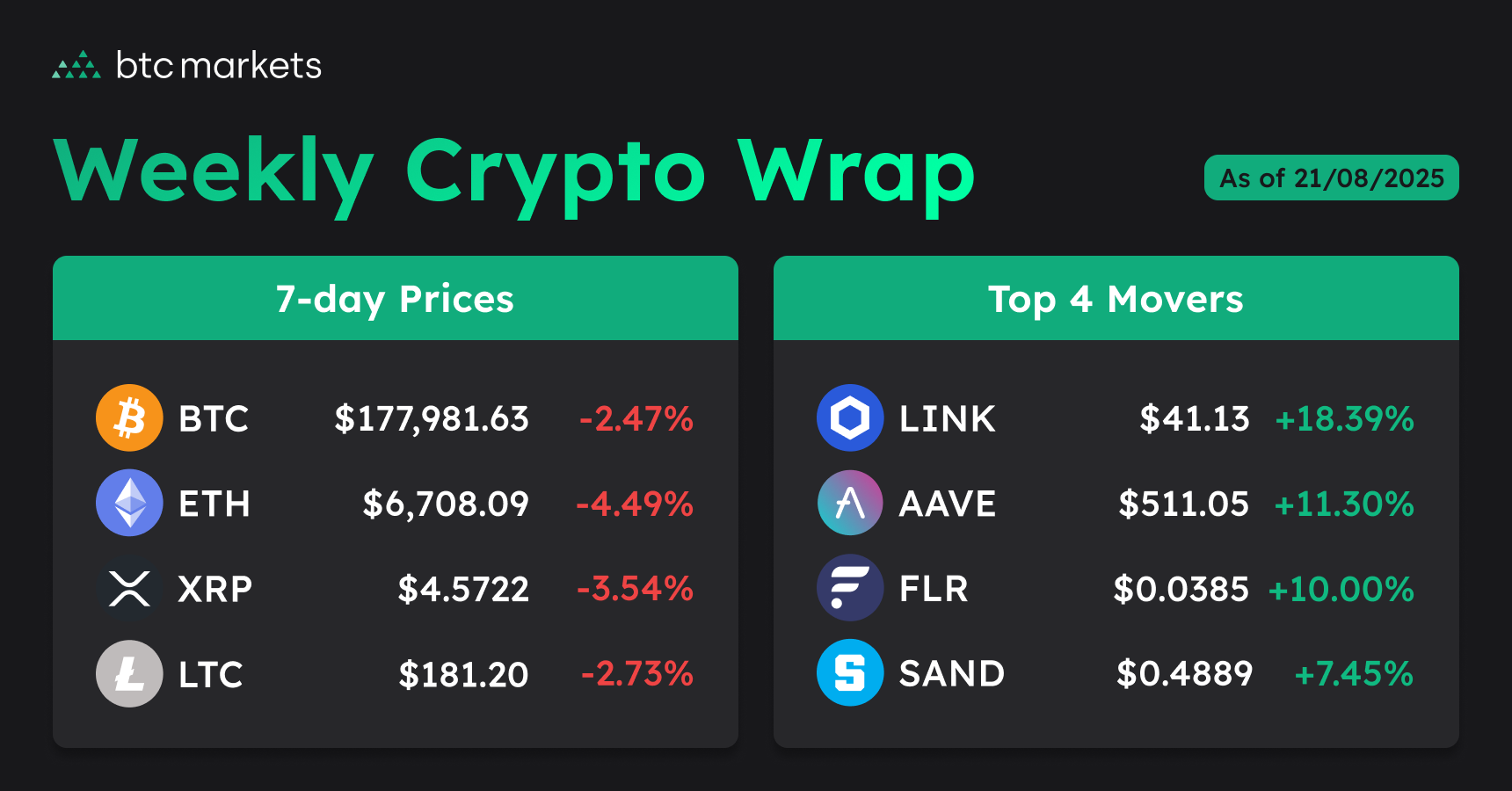
Among the majors, Bitcoin slipped around 8% for the week, re-testing support at US$112,000. Ethereum lost 9% but is holding above US$4,000. Solana fell 7.4% after briefly breaking above the US$200 mark, while XRP defied the broader market with a 2.6% gain. Chainlink stood out with a 10% rally, shaking off the prior week’s pullback, while Stellar, SUI and Litecoin each saw double-digit losses.
The message is clear: money is rotating rather than fleeing. Traders are picking spots, favouring tokens with strong narratives while letting the majors consolidate.
Bitcoin pulls back to consolidation, not a breakdown in trend
Bitcoin’s pullback looks more like consolidation than capitulation. On the 4-hour chart, BTC is sitting in the US$113,000 to US$114,000 range, below both the 50 and 200-hour moving averages, which are converging on a potential bearish cross. Momentum is neutral, with the RSI in the mid-40s.
Short-term, that leaves BTC vulnerable to another test of the ~US$112,000 support. But zooming out, the daily chart still shows an intact uptrend above the 200-day moving average (~US$100,500). Yes, the 50-day has been broken and the EMAs have crossed bearish, but RSI is neutral, not bearish. The key support zone remains US$100,000 to US$105,000. As long as that holds, the bigger picture remains constructive.
All eyes are on Jackson Hole and Fed Chair Jerome Powell’s speech. Traders are effectively waiting for a macro catalyst before committing to the next move.
Check BTC
Ethereum cools off after climbing 115% in two months
Ethereum’s chart tells a similar story. On the 4-hour, ETH is trading just below its 50-hour moving average (~US$4,450) but above the 200-hour (~US$3,940). The RSI sits near 40, suggesting cooling momentum but not a broken trend. Key resistance sits at US$4,250 to US$4,450, while support is layered at US$4,000 to US$4,100 and US$3,950.
On the daily, ETH is comfortably above both the 50-day (~US$3,600) and 200-day (~US$2,580), with the RSI easing from overbought levels into the mid-50s. That shift into neutral territory is healthy, it suggests the rally is catching its breath rather than reversing.
Check ETH
Solana traders lock in gains as price tests the US$200 level
Solana’s recent surge through US$200 was always going to invite profit-taking. It has since retraced to ~US$175, where it’s consolidating around the 200-hour moving average (~US$181). Momentum is neutral, with the RSI in the mid-40s to 50s.
The daily chart still favours the bulls, with support at US$173 (50-day) and US$157 (200-day). A deeper pullback to US$145 to US$155 remains possible, but so does a renewed push higher if Solana can reclaim the US$190 to US$200 zone.
Check SOL
XRP battles to hold the US$3.00 support level
XRP has pulled back to ~US$2.82, below the 50 and 200-hour moving averages (~US$3.09/3.16). The RSI around 40 suggests a neutral stance after earlier gains. For bulls, the key is reclaiming the US$3.00 to US$3.10 zone.
On the daily chart, the uptrend remains intact above the 200-day (~US$2.46). The 50-day (~US$2.97) is the next resistance to watch. A close back above that level, with the RSI pushing north of 50, would strengthen the bullish case.
Check XRP
Crypto ETFs signal balanced capital rotation as investors take profits
Institutional flows tell the same story: pause, not a panic. Bitcoin ETFs now hold US$54.3 billion in cumulative net flows but recorded ~US$653 million in outflows over the past week. Ethereum ETFs hold US$22.3 billion but saw ~US$617 million flow out.
That sounds heavy, but context matters. In both cases, inflows earlier in the month had been strong. What we’re seeing now is rotation and profit-taking. Daily flows have already shown signs of stabilising, with small inflows returning to Ethereum products.
Institutions are still present. They’re just cautious, waiting for macro clarity before ramping up allocations.
The Jackson Hole Economic Policy Symposium
The Jackson Hole Economic Symposium has become a stage where central bankers set the tone for months, if not years. While it started as an academic conference, today it’s where policy direction is often hinted at, and markets treat it as gospel.
This year, tariffs, producer prices and inflation management will dominate. Investors will hang on Powell’s every word when he speaks on Friday. If he leans dovish, risk assets, crypto included, could rally. If he sounds hawkish, expect another wave of caution. Either way, volatility is almost guaranteed.
Crypto Fear & Greed Index
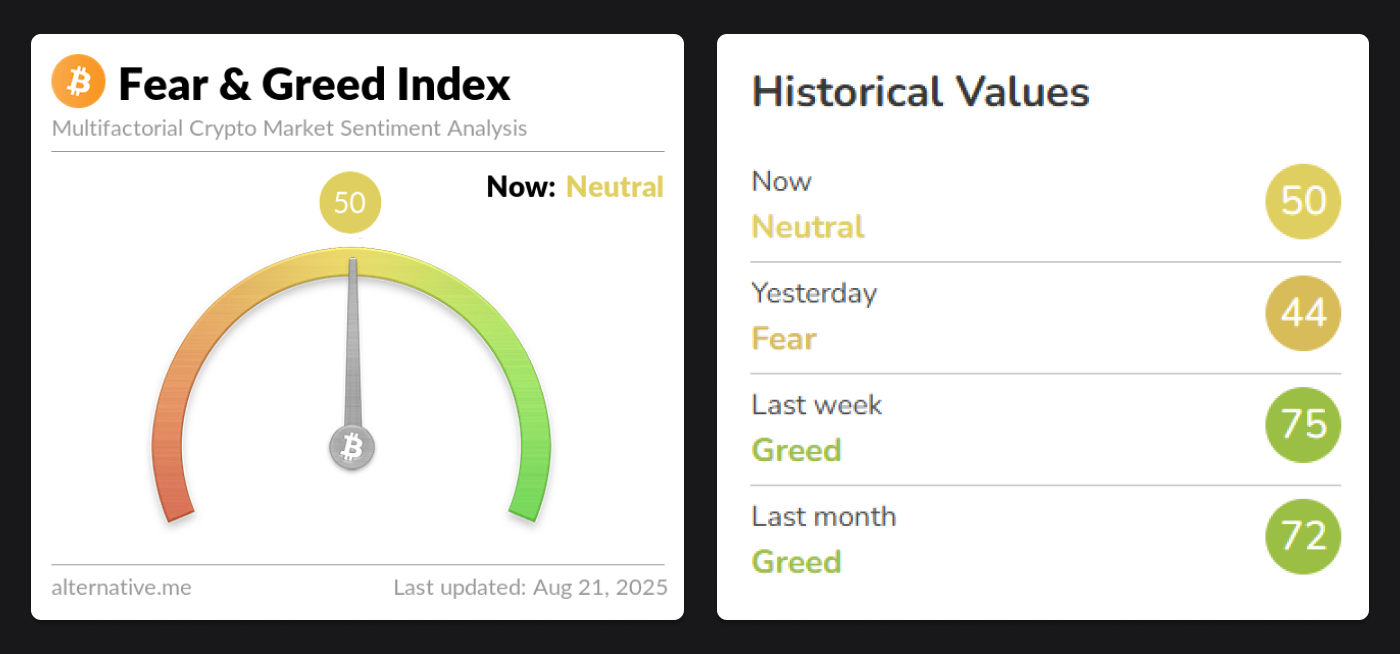
Source: Fear & Greed Index
BTC Markets in the news
Cointelegraph: Ethereum is the ‘biggest macro trade’ for next 10-15 years: Fundstrat
BTC Markets’ crypto analyst, Rachael Lucas, said these positions are strategic and long-term, “taking substantial liquidity out of the market.”
“When you combine record ETF inflows with corporate and sovereign balance sheet allocations, the result is deep structural demand meeting finite supply,” she said, adding:
“That’s a recipe for sustained upward pressure on prices, and a sign that digital assets are firmly embedded in global capital markets.”
The Block: Bitcoin slides to $115,500 as macro data continues to dampen market sentiment
BTC Markets Crypto Analyst Rachael Lucas said spot ETF flow data suggests that the market downturn is more about capital rotation rather than collapsing conviction.
"While daily flows dipped modestly overall, the breadth of institutional engagement remains substantial, suggesting investors are consolidating into lower-cost products rather than exiting the market altogether," Lucas noted.
The Block: Spot Bitcoin ETFs post US$523 million in daily outflows, Ethereum ETFs shed US$422 million as macro factors prompt investor repositioning
"U.S. spot crypto ETFs experienced some of their largest redemptions since launch," said Rachael Lucas, crypto analyst at BTC Markets.
"The scale of these outflows suggests a shift in institutional positioning, either funds are rotating out to lock in profits at recent highs and reallocate into cash or Treasuries, or we are seeing a broader de-risking response to renewed inflation concerns, stronger U.S. dollar moves and uncertainty around the Federal Reserve’s policy path."
Announcements

Introducing your new portfolio experience
Managing your crypto on BTC Markets has just become easier and more intuitive. We’ve upgraded your dashboard to deliver a brand-new portfolio experience.
What’s included in this release
We’ve brought together the features that matter most, giving you a solid foundation to track and manage your crypto.
- Portfolio tracking
See the total value of your portfolio and monitor changes over time. - Crypto holdings
Get a breakdown of your holdings and balances. - Unrealised profit & loss
View how your portfolio and individual assets are performing with unrealised profit & loss. - Quick actions
Quickly transact from your portfolio to manage your assets efficiently - whether it’s buying, selling or transferring.
You can access your new portfolio via the ‘Get started’ link below or by clicking the ‘New experience’ link in the navigation bar on the exchange platform.
Simplify your tax reporting with 30% off premium tools
BTC Markets has partnered with Crypto Tax Calculator to help streamline your crypto tax reporting. New customers can access a 30% discount on all paid plans using the code BTCM2025.
This limited-time offer is valid until October 31, 2025, and can be redeemed here.
For more details on crypto tax reporting, read our tax blog or visit our support page.
The week ahead: Economic events
Thursday, August 21st
- United States Fed Funds Interest Rate, Existing Home Sales
- Germany Manufacturing PMI
- United Kingdom Manufacturing PMI, Services PMI
Friday, August 22nd
- Japan Inflation Rate
- United Kingdom Retail Sales MoM
- United States Fed Funds Interest Rate
Monday, August 25th
- Germany Ifo Business Climate Index
Tuesday, August 26th
- Australia Interest Rate
- United States Durable Goods Orders
Wednesday, August 27th
- Germany GfK Consumer Climate
Source: Trading Economics
Market reflections
- United States: Inflation tug-of-war keeps markets on edge
- Eurozone: Steady but slow growth offers limited volatility drivers
- China: Fragile growth signals pose risks for global sentiment
- Japan: Steady growth and softening inflation keep markets calm
- Australia: Rate cuts and strong jobs data support crypto demand
United States: Inflation tug-of-war keeps markets on edge
July CPI offered a mixed picture, with headline inflation easing to 2.7% year-on-year and core at 3.1%, sparking hopes of a cooling trend. But the Producer Price Index jumped 0.9% month-on-month, the fastest rise in three years, reminding markets that upstream cost pressures remain stubborn. Retail sales advanced 0.5%, signalling steady consumer demand, while industrial production slipped slightly, highlighting uneven growth.
For crypto, this combination feeds near-term volatility as traders await clarity from the US Federal Reserve ahead of key September guidance. Risk appetite may ebb and flow depending on how investors interpret the tug-of-war between softer consumer inflation and persistent producer costs. Short-term, expect sharp swings in Bitcoin and Ethereum around Fed commentary, but the broader uptrend remains supported by institutional accumulation and structural adoption.
Eurozone: Steady but slow growth offers limited volatility drivers
Economic growth in the eurozone remains modest. Q2 GDP grew just 0.1% quarter-on-quarter, reflecting subdued momentum, while July CPI held steady at 2.0%, with core inflation easing to 2.3%, lowest since early 2022. Stability is evident, but the region shows little in the way of acceleration.
For crypto markets, Europe’s steady backdrop offers limited direct drivers, but it does reduce the likelihood of volatility spilling over from the region. Investors remain more focused on US policy cues, but euro stability provides a calm counterweight to global macro swings. Digital assets continue to track risk sentiment and macro flows, meaning any sharp directional moves are more likely to originate from the US or China rather than Europe itself.
China: Fragile growth signals pose risks for global sentiment
China’s macro data underlined ongoing fragility. Industrial production slowed to 5.7% year-on-year, retail sales fell to 3.7%, and fixed-asset investment barely grew. The PBoC maintained a cautious approach, favouring targeted support measures rather than broad rate cuts. Weak domestic demand in the world’s second-largest economy has global ripple effects, weighing on risk appetite.
For crypto, this reinforces the tight correlation with macro forces, sluggish Chinese activity dampens sentiment, and combined with US volatility, creates choppy conditions for digital assets. Traders may see consolidation and selective accumulation rather than broad-based rallies, highlighting the continued sensitivity of Bitcoin and Ethereum to global growth trends.
Japan: Steady growth and softening inflation keep markets calm
Japan posted steady Q2 GDP growth at 1.0% annualised, supported by consumption and exports, while Tokyo’s core CPI cooled slightly to 2.9%, still above the central bank’s target. Capital spending was healthy, and net exports contributed positively.
For crypto, the immediate impact is limited, but currency movements, particularly a firmer yen, could influence carry trades and flows into digital assets. The BoJ’s gradual stance on monetary policy keeps spill-over risks muted, allowing digital assets to respond primarily to global macro trends rather than domestic shocks. Investors can view this as a stabilising factor amidst broader volatility, with Japan providing a predictable backdrop relative to more turbulent US and Chinese markets.
Australia: Rate cuts and strong jobs data support crypto demand
The RBA cut the cash rate by 25 basis points to 3.6% on 12 August, its third reduction this year, signalling continued easing support. Yet, the labour market remains resilient. July employment rose by 24,500, full-time jobs jumped 60,500, and unemployment fell to 4.2%.
For crypto, lower rates may support household sentiment and spending, potentially boosting digital asset demand. Currency weakness may enhance Bitcoin’s appeal as a hedge, while domestic economic stability underpins cautious optimism. This combination positions Australia as a supportive environment for crypto adoption, even as global volatility and macro uncertainty drive caution elsewhere.
Closing thoughts
Markets are at a crossroads. Inflation is cooling in some places, heating in others. Growth is steady in pockets but faltering elsewhere. For investors, it means patience is essential.
Crypto has pulled back, but that’s natural after such strong gains. The bigger picture, long-term adoption, institutional participation, mainstream integration, remains firmly intact. Bitcoin above US$113k, Ethereum above US$4k, and a global crypto market cap near US$4 trillion is hardly a bearish backdrop.
Jackson Hole will be the next inflection point. Whether Powell leans dovish or hawkish, traders will adjust quickly. What matters most is that crypto is no longer on the sidelines. It’s trading in step with global macro.
Scam alert

Jobs and employment scams: Don’t pay to get paid
Scammers are targeting job seekers with offers that promise quick cash for little effort - but the roles don’t exist. These fake opportunities often impersonate well-known companies or recruiters.
You may be asked to pay upfront through bank transfer, PayID, or cryptocurrency to “activate” the job or complete tasks. The scammer disappears with your money or personal details. Sometimes they even provide small initial payments to build trust, before demanding more.
These scams are designed to create urgency and stop you from checking the facts.
Warning signs it could be a scam
- Unexpected approaches through text or encrypted apps like WhatsApp, Signal, or Telegram.
- Easy, high-paying roles with no interview or questions about your experience.
- Requests for upfront payment or cryptocurrency deposits to access work or complete tasks.
- Jobs involving transferring funds, making purchases, or handling packages for others.
- Pressure to act quickly or pay “recruitment fees” or training costs.
How to protect yourself
- Be cautious with job ads, even on trusted platforms - scammers post fake listings too.
- Never send money or share banking or crypto details with someone you only know online.
- Verify recruiters through official company websites, not links in a message.
- Take your time. Genuine opportunities won’t ask you to pay upfront.
- Don’t share sensitive personal details (like passports or ID) unless you’re certain the employer is legitimate.
If you’ve been targeted, secure your accounts immediately and update your passwords.
Report scams and find more advice at scamwatch.gov.au.
Stay up to date on the latest news in the crypto space.
Sign up for free and join over 374,000 Australian traders who receive the BTC Markets Weekly Crypto Wrap.
Subscribe to our status page for live system updates or follow us on X.
Feedback
If you have any feedback on our newsletter or want to request specific content, please submit a support ticket and we will respond shortly.
Disclaimer: The information provided on this page is issued by BTC Markets Pty Ltd (BTC Markets, we, us, our). The information is general only and is not intended to constitute an opinion or recommendation with respect to its contents. Past performance is not a reliable indicator of future performance. Any reference to past performance is intended to be for general illustrative purposes only. The information cannot be relied upon for any purposes and is not intended to be a substitute for professional advice.
The information does not purport to be complete, accurate or contain all of the information that a person may require to make a decision. It may also contain forward looking statements, which are subject to known and unknown risks, uncertainties, and other factors. We recommend you obtain professional advice before making any decision with respect to the matters discussed in this document. To the maximum extent permitted by law, BTC Markets will have no liability for any loss or liability of any kind: (i) arising in respect of the information contained (or not contained) on this page; or (ii) arising from a person relying on any information or statement contained on this page. The information provided is only intended for recipients in Australia. This information cannot be reproduced without our prior written permission.
Get BTC Markets content delivered
Keep up to date with the latest from BTC Markets. Unsubscribe anytime.SubscribeFind out the latest crypto news