![[object Object]](https://cdn.sanity.io/images/yz4v1m0i/production/3c2ceffdd9e5617da853f9e0c40c29afcd4cac70-2000x2000.png?w=48&h=48&fm=webp&fit=min)


Crypto can feel overwhelming at first. With new financial ideas, unfamiliar jargon, and a tangle of acronyms, it’s easy to confuse terms like coin and token, even though they play very different roles. In this guide, we answer questions like, “what is the difference between a crypto coin and token?”, discuss what they actually are, how they work, and how you can trade them on BTC Markets.
What is a coin in cryptocurrency?
A cryptocurrency coin is a digital asset that runs on its own dedicated blockchain. Coins are primarily used as a form of digital currency, serving as a means of exchange, a store of value, or a unit of account. Let’s take a look at a few well-known coins.
Bitcoin (BTC), launched in 2009, was the first cryptocurrency and remains a digital store of value. Ethereum (ETH), though often grouped with coins, plays a broader role in enabling decentralised applications (often abbreviated to DApps). Other examples include Litecoin (LTC) and XRP, both designed for faster, lower-cost transactions. These coins are essential to the functioning of their own networks; without them, their individual blockchains wouldn’t operate.
Coins are usually created through mining (in proof-of-work systems like Bitcoin) or staking (in proof-of-stake systems like Ethereum after its major upgrade). In both cases, they act as incentives that help secure and run the blockchain network.
What is a token in cryptocurrency?
Instead of building a blockchain from the ground up, many projects opt to create tokens. These tokens serve different functions depending on the project’s goals. For example:
- Utility tokens are used to access a service or product.
- Governance tokens allow holders to vote on project-related decisions.
- Security tokens may represent ownership of real-world assets such as shares, property, or commodities, and can include regulatory features.
- Stablecoins are pegged to fiat currencies (e.g. US dollar), aiming to provide price stability. Examples include USDC and USDT.
One popular token standard is ERC-20 on the Ethereum blockchain. These tokens follow a common technical framework, which ensures compatibility with Ethereum-based wallets and exchanges. Well-known tokens such as Chainlink (LINK) and Uniswap (UNI) are built using this standard. Because tokens use the infrastructure of an existing blockchain, they’re often faster and cheaper to create. However, they rely entirely on the host blockchain for security and operation.
Comparing coins and tokens
To make the distinction clearer, here’s a quick summary comparison of the two:
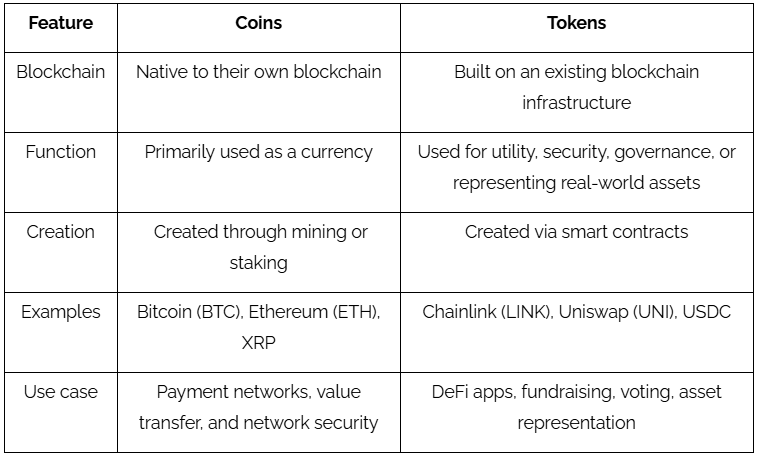
In simple terms, coins power the blockchain, while tokens run on top of it.
Memecoins - the speculative exception
There’s one category that blurs the line between both coins and tokens—memecoins. These are often created more for fun or community engagement than for utility. Technically, many memecoins are tokens. But in practice, community naming conventions often override the technical details, especially in the fast-moving world of retail trading.
Why the confusion?
The term memecoin first started with Dogecoin (DOGE) in 2013. Since DOGE has its own blockchain, it’s technically a coin. As the first memecoin, this set the naming trend. In most cases, people refer to meme-based assets as memecoins regardless of whether they’re technically coins or tokens, and it has become the language and culture of most memecoin communities. In reality, retail traders rarely distinguish between coins and tokens when talking about speculative meme assets.
One standout example came in 2024, when the no-code platform Pump.fun made it possible for anyone to launch a memecoin on Solana for just 0.2 SOL. Within Pump.fun’s first year of operation, they helped launch over 7 million memecoins, most of them technically tokens, although widely called coins by their communities.
Examples of popular coins and tokens
BTC Markets offers access to a wide selection of both tokens and coins. Here are a few examples available for trading:
Popular coins on BTC Markets:
Bitcoin (BTC) – the original digital currency.
Ethereum (ETH) – used in DeFi apps and for smart contracts.
XRP – supporting fast and low-cost cross-border transactions.
Solana (SOL) – a high-speed blockchain known for handling large transaction volumes and hosting memecoin projects.
Popular tokens on BTC Markets:
Chainlink (LINK) – brings real-world data onto blockchain networks.
Uniswap (UNI) – used for governance on the Uniswap decentralised exchange.
USD Coin (USDC) – a stablecoin pegged to the US dollar.
You can view the full list of supported digital assets by visiting BTC Markets Supported Assets.
Trading tokens and coins on BTC Markets
To start trading:
- Sign up for a BTC Markets account and complete your identity verification.
- Deposit funds in AUD or crypto.
- Browse the available assets, whether you're interested in tokens or coins.
- Place your trade using our simple, secure platform.
Whether you’re just starting or looking to expand your portfolio, BTC Markets provides the tools to support your crypto journey, from charts to educational guides. Just remember: like all investing, crypto carries risk. Only trade what you’re comfortable with.
To learn more about trading digital assets, visit BTC Markets.
Get BTC Markets content delivered
Keep up to date with the latest from BTC Markets. Unsubscribe anytime.SubscribeFind out the latest crypto news

Bitcoin bends but holds as rate fears return