![[object Object]](https://cdn.sanity.io/images/yz4v1m0i/production/38f2c02224d5ea8d551881949e819f95a9952e46-3972x5243.jpg?rect=0,0,3972,3972&w=48&h=48&fm=webp&fit=min)


Sign up to our weekly newsletter
Stay informed on the latest market updates – subscribe to our weekly newsletter today.
Introduction
The week delivered a clear risk reset. Bitcoin briefly fell to US$87,263, its lowest level since late December, before recovering above US$90,000 as global sentiment weakened on renewed US tariff threats. More than US$1 billion in liquidations hit the majors, with longs taking most of the impact. Gold pushed to fresh highs near US$4,888, highlighting Bitcoin’s continued behaviour as a high beta asset rather than a defensive hedge. ETF flows reflected the mood, with redemptions across Bitcoin, Ethereum and XRP, while Solana held firm. Beneath the volatility, whales accumulated, retail reduced exposure, and institutional activity in Ethereum and stablecoins continued to build.
Check prices on the BTC Markets exchange.
Price action on Australia’s digital asset exchange
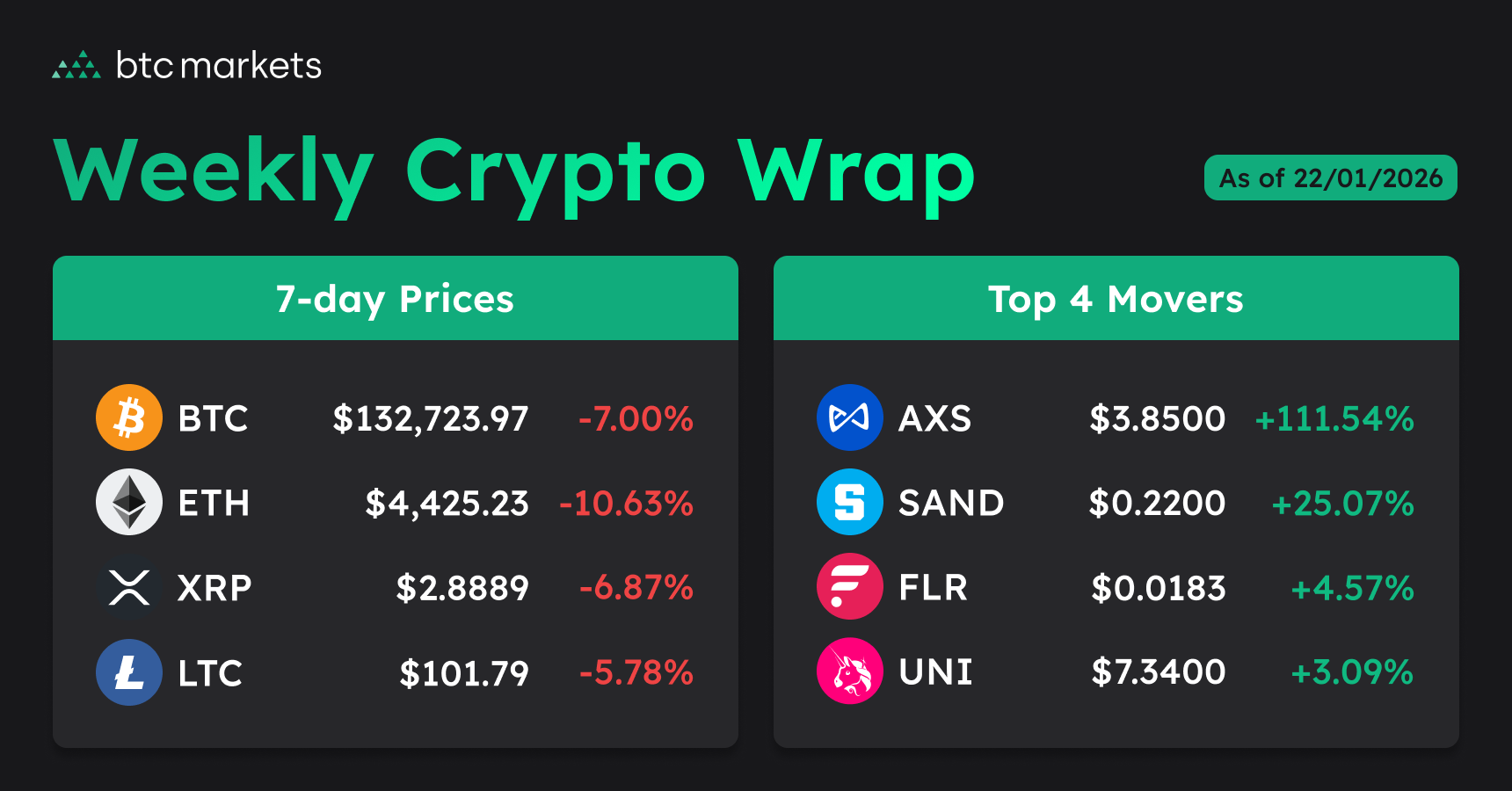
On the BTC Markets platform, Bitcoin led the market lower this week, slipping to AU$132,723.97, down 7%, as risk appetite softened across global markets. Ethereum underperformed, falling 10.63% to AU$4,425.23, making it the weakest of the major assets tracked. XRP held up slightly better but still closed the week 6.87% lower at AU$101.79.
The broader crypto market cap now sits at US$2.99T, reflecting a clear riskoff tone across the sector. Despite the pullback, Bitcoin’s dominance edged up to 59.58%, signalling that traders are rotating back into BTC as a relative haven during periods of uncertainty.
Overall sentiment remains cautious. BTC’s smaller decline compared with ETH and XRP suggests the market is consolidating rather than capitulating, with investors waiting for the next macro catalyst. For now, Bitcoin continues to anchor the market, while altcoins remain more sensitive to shifts in sentiment.
State of crypto
- Bitcoin fell to US$87,263, rebounded above US$90,000, volatility stayed elevated
- Over US$1B in liquidations, longs absorbed most of the damage
- US spot Bitcoin ETFs saw notable outflows as risk appetite faded
- Whales accumulated US$3.2B in BTC, retail trimmed exposure
- Ethereum adoption deepened across institutions, stablecoin supply hit a record
- Policy signals constructive yet uncertain, near-term volatility likely to persist
Bitcoin and macro, volatility drives a sharp reset
Bitcoin’s slide to US$87,263, followed by a recovery above US$90,000, framed a week defined by macro stress and positioning clean up. Renewed tariff threats from the US stoked broad risk aversion across assets, and crypto felt the impact quickly. More than US$1 billion in liquidations washed through the market, with longs taking most of the damage, a typical signature of a fast, liquidity driven downdraft. The drawdown reset overbought conditions that had built through early January, while open interest and funding cooled from elevated levels. That helped reduce the risk of a deeper cascade.
The comparative move in gold underscored the risk regime. With spot gold printing fresh highs near US$4,888, the cross-asset message was clear. Investors looked for safety and positioned away from high beta exposure in the near term. This did not invalidate the long-term digital gold narrative, but it reminded traders that Bitcoin still trades like a risk asset when policy uncertainty spikes. For technicians, the round number and prior range support near US$90,000 remains an important pivot. A sustained hold and rebuild of momentum above that zone would encourage dip buyers. A failure would keep the market vulnerable to another liquidity sweep into the high US$80,000.
Check BTC
Positioning, ETFs, and the whale retail split
Institutional flows leaned negative as US spot Bitcoin ETFs recorded notable outflows, led by larger issuers. With geopolitical and trade uncertainty rising, many allocators chose to de risk, reducing a support pillar that had been present for months. Ethereum and XRP products also saw redemptions, while Solana stood out with modest inflows. Outflows often amplify short term price moves, but they can also reset positioning to healthier levels, especially after strong prior inflows.
Under the surface, large holders continued to accumulate, adding an estimated US$3.2 billion in BTC over nine days, while smaller retail wallets reduced exposure. This divergence has historically been associated with late-stage selloffs, when weak hands capitulate and strong hands step in. It is not a timing tool on its own, but in combination with cooler derivatives metrics, it points to improving medium term risk reward. Corporate demand stayed present as well. Strategy completed its largest purchase in a year, adding more than 22,000 BTC. The market reaction was mixed, given the subsequent dip below US$90,000 and questions about funding mix, but the signal was consistent. Balance sheet buyers remain engaged, and they typically buy weakness rather than strength.
Check SOL
Ethereum adoption and stablecoin liquidity build the base
While price volatility grabbed headlines, Ethereum’s institutional traction continued to expand. More than 35 major financial institutions now operate live tokenisation and settlement initiatives on Ethereum, spanning money market funds, tokenised deposits and stablecoins. Staking participation has climbed, and network level activity, from wallet creation to on chain settlement, continues to trend higher. That institutional build out matters because it anchors real world use cases and brings durable flows that are less sensitive to week-to-week price swings.
Stablecoins told a similar story of underlying strength. Total supply reached a record US$307.7 billion, with new USDT and USDC issuance adding to market liquidity. Historically, rising stablecoin float coincides with elevated buying power, even if it does not rotate immediately into spot crypto. The stablecoin supply ratio moved lower after the Bitcoin correction, indicating improved relative purchasing capacity. For traders, that suggests potential fuel for rebounds once macro uncertainty eases. For builders and institutions, it signals a deepening pool of on chain liquidity to support settlement, payments and tokenised assets. Together, Ethereum’s institutional activation and expanding stablecoin base form a constructive foundation beneath headline volatility.
Check ETH
Policy outlook, constructive signals with unresolved details
Policy remained a key swing factor. President Trump reiterated support for market structure legislation, including the CLARITY Act, with an aim to position the US as a leader in digital assets. Markets initially rallied on the signal, then faded as uncertainty around stablecoin yield restrictions reasserted itself. Coinbase’s stance shift on that specific provision highlights the tension between fostering innovation and protecting investors. For markets, clarity on custody, disclosures, and stablecoin frameworks would likely compress risk premia and encourage longer duration capital.
In the near term, traders should expect policy headlines to produce short, sharp moves, both higher and lower. The bigger picture remains more favourable than in prior cycles. There is bipartisan momentum to provide rules of the road, and industry engagement is high. For allocators, that argues for a barbell, with core positions in assets benefiting from clear demand and utility, and tactical overlays to manage event risk. For builders and institutions, it is an invitation to keep shipping, aligning product design with the likely direction of regulation rather than the status quo.
Check XRP
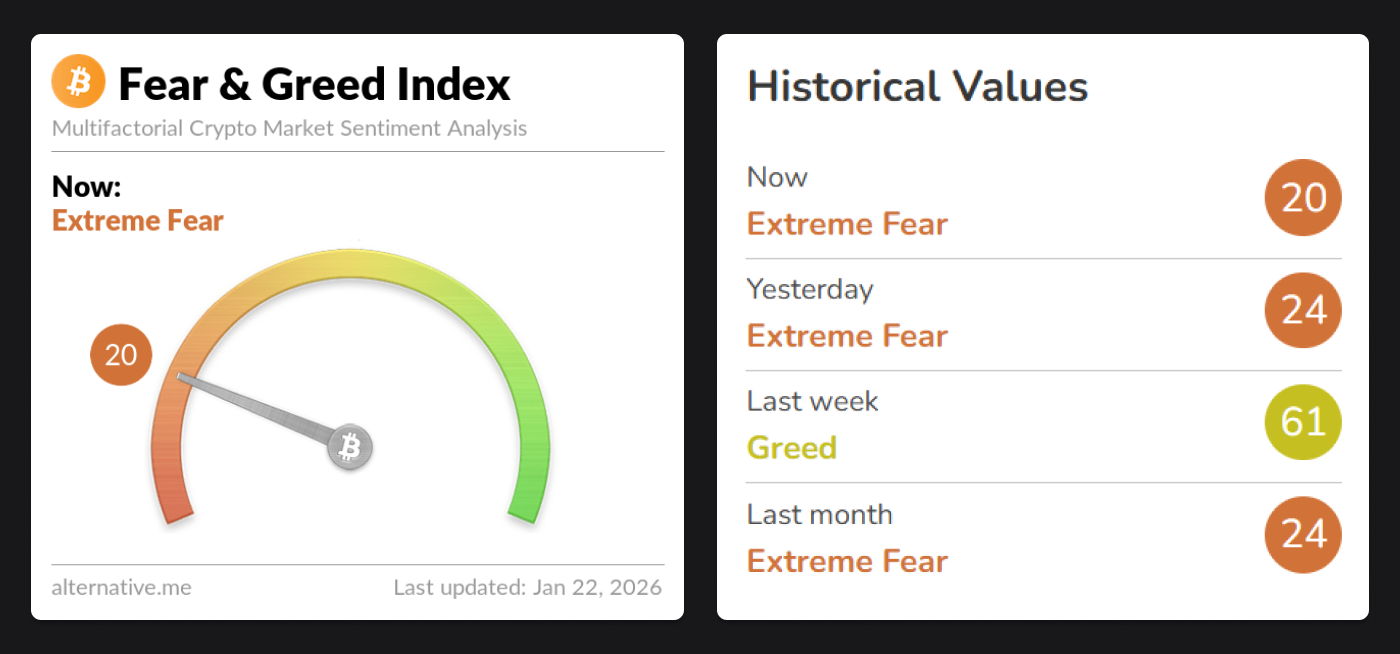
Crypto Fear & Greed Index
Source: Fear & Greed Index
BTC Markets in the news

AFR: Bitcoin closes in on $US100k as billions pile into ETFs
Industry pundits said that with the rally pushing the digital asset within striking distance of six figures, an important psychological threshold for investors had been crossed.
“The break above $US94,400 was pretty critical in terms of giving the market a sign of life,” said BTC Markets head of finance Charlie Sherry.
“This has been a key level going back to the US election and has continued to matter more recently.”
InvestorDaily: Bitcoin’s comeback fuels optimism for 2026
Bitcoin surged on 14 January (15 January AEST), breaking out of its recent range to briefly top US$96,000 before settling near US$95,000, according to BTC Markets.
The move marks what the firm’s head of finance, Charlie Sherry called a “decisive breakout” for the cryptocurrency, which had been stuck between US$92,000 and US$94,000 for weeks amid broader risk-off sentiment after touching US$100,000 on 14 November.
Announcements

Introducing AI News & Insights
We’ve launched AI News & Insights, a new tool designed to bring you fast, reliable updates on the latest market trends and events. Our AI engine scans trusted sources, summarises key developments, and delivers clear insights, all in one place. You can access AI News & Insights from the Explore section on the Simple Trade platform.

Women bring larger, deliberate investment
The BTC Markets Investor Study Report 2025 highlights a meaningful rise in participation from female investors. For the first time in five years, women recorded a higher average initial deposit than men, increasing by 115% year on year.
Read the Investor Study Report
The week ahead: Economic events
Thursday, January 22nd
- Japan Balance of Trade
- United States GDP Growth Rate, Core PCE Price Index MoM, Personal Income, Personal Spending
Friday, January 23rd
- Japan Inflation Rate, Interest Rate
- United Kingdom Retail Sales MoM, Manufacturing PMI, Services PMI
- Germany Manufacturing PMI
Monday, January 26th
- Germany Ifo Business Climate Index
- United States Durable Goods Orders
Tuesday, January 27th
- Australia Business Confidence
Wednesday, January 28th
- Germany GfK Consumer Climate
- Canada Interest Rate
Source: Trading Economics
Market reflections
- United States: Dollar climbed as falling jobless claims pushed back expectations for Fed rate cuts
- Europe: ECB policymakers warned against complacency as policy and market risks remained elevated
- China: Growth outlook softened, with economists forecasting expansion to slow to around 4.5% in 2026
- Japan: Inbound tourism hit record levels despite a sharp drop in visitors from China
- Australia: Household spending remained firm, complicating the RBA’s policy outlook
Markets responded to a mix of labour data, policy signals, and growth outlooks this week. In the United States, the dollar strengthened after jobless claims declined, prompting markets to push back expectations for Federal Reserve rate cuts as labour conditions remained resilient.
In Europe, central bank messaging remained cautious. ECB officials warned against complacency, highlighting the risks posed by external policy uncertainty and shifting market dynamics even as inflation pressures continued to ease.
China’s economic outlook drew renewed attention after economists projected growth to slow to around 4.5% in 2026. The forecast reflected ongoing challenges from weak domestic demand and structural headwinds, reinforcing expectations for further policy support.
Japan saw contrasting signals. Inbound tourism reached record highs, providing support to services activity, though the sharp decline in visitors from China highlighted uneven regional demand.
In Australia, household spending remained firm in November, adding to the Reserve Bank’s caution as it balances resilient demand against lingering inflation risks.
Taken together, markets appeared less focused on growth momentum and more on how central banks respond to pockets of resilience and weakness.
Final thoughts
Markets are sitting between macro caution and underlying structural strength. Bitcoin’s ability to hold the US$90,000 level remains a key guide for sentiment, alongside ETF flow direction and whether whale accumulation continues through volatility. On Ethereum, strong institutional activity and steady stablecoin expansion are reinforcing the network’s foundations, even as short-term price action remains choppy. Policy signals are broadly constructive, but the details still matter, keeping headline risk elevated. Overall, conditions reflect a market adjusting to macro pressure while continuing to build long-term infrastructure, with liquidity, institutional participation and regulatory clarity shaping the path forward.
Ready to take advantage of the opportunities shaping the market? Log in to trade on Australia’s own digital asset exchange and stay positioned for what comes next.

Online safety: How to spot impersonation attempts
Impersonation attempts occur when someone pretends to be a bank, crypto exchange, government agency, or even someone you know. These messages may use familiar names, altered contact details, or convincing language to make the communication appear genuine.
You may receive texts, emails, or calls that look official and claim there is an urgent issue with your account or recent activity. Some may request personal information or direct you to click a link to “verify” details. These tactics aim to create pressure so that you respond before checking the source.
What to watch out for
- Messages containing links that ask for logins or personal information.
- Urgent requests that ask you to act quickly to resolve a supposed issue.
- Calls or texts claiming to be from government agencies that mention legal action or arrest.
- Business payment instructions that suddenly change bank account or BSB details.
- Contacts who say they have a new number but avoid confirming their identity.
How to stay safe
- Avoid clicking links or downloading attachments from unfamiliar sources.
- Confirm the message by reaching out to the organisation using official contact details.
- Pay attention to subtle changes in phone numbers, email addresses, or names.
- End the conversation if the tone becomes threatening or intimidating.
- Verify the identity of anyone claiming to be a friend or family member with a new number.
Learn more at scamwatch.gov.au.
Stay up to date on the latest news in the crypto space.
Sign up for free and join over 380,000 Australian traders who receive the BTC Markets Weekly Crypto Wrap.
Subscribe to our status page for live system updates or follow us on X.
Feedback
If you have any feedback on our newsletter or want to request specific content, please submit a support ticket and we will respond shortly.
Disclaimer: The information provided on this page is issued by BTC Markets Pty Ltd (BTC Markets, we, us, our). The information is general only and is not intended to constitute an opinion or recommendation with respect to its contents. Past performance is not a reliable indicator of future performance. Any reference to past performance is intended to be for general illustrative purposes only. The information cannot be relied upon for any purposes and is not intended to be a substitute for professional advice.
The information does not purport to be complete, accurate or contain all of the information that a person may require to make a decision. It may also contain forward looking statements, which are subject to known and unknown risks, uncertainties, and other factors. We recommend you obtain professional advice before making any decision with respect to the matters discussed in this document. To the maximum extent permitted by law, BTC Markets will have no liability for any loss or liability of any kind: (i) arising in respect of the information contained (or not contained) on this page; or (ii) arising from a person relying on any information or statement contained on this page. The information provided is only intended for recipients in Australia. This information cannot be reproduced without our prior written permission.
Get BTC Markets content delivered
Keep up to date with the latest from BTC Markets. Unsubscribe anytime.SubscribeFind out the latest crypto news