![[object Object]](https://cdn.sanity.io/images/yz4v1m0i/production/3c2ceffdd9e5617da853f9e0c40c29afcd4cac70-2000x2000.png?w=48&h=48&fm=webp&fit=min)


When people think of cryptocurrencies, Bitcoin and Ethereum are usually top of mind. XRP? Not so much. It doesn’t make headlines like Bitcoin or ride meme waves like DOGE. But beneath the surface, XRP operates more like a silent engine, quietly enabling banks and financial institutions to move money across borders seamlessly.
While other cryptocurrencies chase decentralised finance, NFTs, or meme status, XRP is focused on solving real-world problems by making global payments faster, cheaper, and more efficient. In this guide, we’ll break down what XRP is, how it works, and why it’s gaining renewed relevance in the world of finance, even if you’re only just hearing about it now.
What is XRP?
XRP is a digital asset designed to enable faster, cheaper, and more efficient global payments. It runs on the XRP Ledger - a decentralised blockchain created in 2012 with a specific mission to improve how value moves across borders.
While it’s easy to confuse XRP with Ripple (the company), it’s essential to know they’re not the same. Ripple is a fintech company that utilises XRP in some of its products. XRP is an open-source cryptocurrency that can be used by anyone. This distinction is important to understand, as it means XRP can operate independently of Ripple and can be supported and utilised by other institutions and developers.
Unlike Bitcoin, which is mined over time, all 100 billion XRP tokens were created at launch. A large portion was allocated to Ripple Labs, but XRP can now be bought and sold on exchanges by anyone.
XRP serves as a bridge currency for global financial transactions. It enables the swift and efficient conversion of one currency to another, simplifying cross-border transfers and minimising the need for multiple intermediaries. This function is a key part of Ripple's On-Demand Liquidity (ODL) solution.
How did XRP get started?
The roots of XRP date back to 2004 with a project called RipplePay, although the XRP Ledger as we know it today was launched in 2012 by three engineers - Jed McCaleb, David Schwartz, and Arthur Britto. Like many of the early cryptocurrencies, the XRP team looked at the initial power of Bitcoin to create alternative payment rails that enable two parties to send funds to each other without going through a bank. They saw the power, but also saw that Bitcoin had one major flaw - it could only handle around 7 transactions per second. This limitation resulted in network congestion and slow transaction times during periods of high demand. By comparison, at the time, Visa had an estimated 30,000 transactions per second. When Chris Larsen, a seasoned entrepreneur, joined the XRP project in 2012, helping to shape the vision of revolutionising cross-border payments, the expanded team founded a company initially named OpenCoin, which was later rebranded as Ripple Labs. The team believed that Bitcoin lacked sufficient technical capabilities to meet the international payment needs of global banks. Equally, they sought to address the flaws of the existing international payment rail, SWIFT, which they perceived as outdated and inefficient.
XRP and SWIFT – challenging the old guard
To understand XRP’s role, it is helpful to examine the system it aims to disrupt - SWIFT. Short for the Society for Worldwide Interbank Financial Telecommunication, SWIFT was launched in the 1970s to replace slower systems, such as Telex. Today, it acts as the messaging network that underpins most international bank transfers.
But there’s a catch. SWIFT doesn’t actually move money - it simply sends payment instructions between banks. The process involves a chain of correspondent banks, each one adding delays, fees, and potential points of failure. Cross-border payments through SWIFT can take anywhere from one to five business days to settle.
XRP was designed to bypass this clunky system. Its blockchain, the XRP Ledger, allows payments to settle quickly without the need for multiple intermediaries. This not only reduces cost and complexity but also dramatically increases speed and reliability.
With XRP, banks can move value as easily as sending an email. That’s why Ripple, the company behind some of XRP’s use cases, has developed On-Demand Liquidity (ODL), a solution that uses XRP as a bridge between currencies. It enables almost instant settlement without pre-funded accounts or third-party clearinghouses - a significant leap beyond the existing banking rails.
In contrast to the SWIFT messaging system, banking blockchain-based systems like the XRP Ledger can settle international payments in seconds, not days.
So, let’s see how XRP works - with a little bit of technology added in - but not too much!
How does XRP work?
At the heart of XRP is the XRP Ledger (XRPL), a decentralised, open-source blockchain optimised for speed, scalability, and cost-efficiency. Unlike Bitcoin, XRP doesn’t have miners that mine XRP. Instead, it utilises a unique consensus mechanism known as the Ripple Protocol Consensus Algorithm (RPCA).
Ripple Protocol Consensus Algorithm (RPCA)
Here’s how the (RPCA) works in plain English. Instead of relying on a single central authority or a slow mining process (like Bitcoin), XRP utilises a network of trusted computers called validators. These validators talk to each other and quickly compare notes on which transactions should be approved. If at least 80% of them agree, the transaction goes through and is permanently added to the ledger.
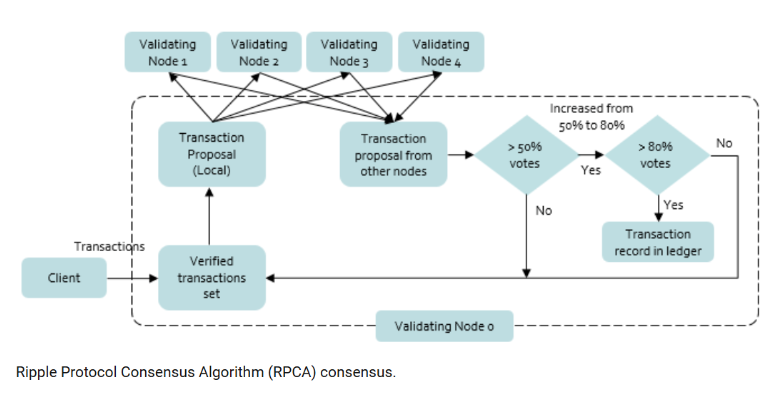
This system is fast, energy-efficient, and allows XRP transactions to be confirmed in just 3–5 seconds.
Unlike miners, validators do not receive transaction fees; instead, a very small amount of XRP is destroyed with each transaction, making XRP slightly deflationary over time, which improves the supply-demand equation for XRP holders in the long term.
How does an XRP transaction work in practice?
Here’s how XRP enables a seamless international transaction:
- A sender initiates a payment in their local currency.
- That currency is instantly converted into XRP.
- XRP is sent across the XRP Ledger within seconds.
- At the destination, XRP is converted into the local currency.
This entire process can be completed in under 10 seconds, with a fee of less than a fraction of a cent.
You can probably understand why banks love the XRP technology.
Why is XRP valuable?
XRP holds value for several reasons, particularly due to its technical strengths and practical applications in the real world. Here’s a breakdown of why investors and institutions alike have been paying attention to XRP:
- Speed: Transactions settle in typically 3–5 seconds.
- Low Fees: The transaction cost is approximately $0.0002 per transaction.
- Scalability: Capable of handling 1,500+ transactions per second.
- Green Technology: Negligible energy use compared to Bitcoin.
- Liquidity Tool: Ideal for institutions looking to transfer funds globally.
Its deflationary model means that over time, the total supply slowly decreases, which may have the effect of supporting its value as adoption increases. Because XRP is designed for high-volume transfers, it’s a natural fit for remittances, forex trading, and global settlements.
Despite XRP’s clear competitive advantage over SWIFT, its journey hasn’t all been plain sailing…
SEC vs XRP
In December 2020, the U.S. Securities and Exchange Commission (SEC) filed a lawsuit against Ripple, alleging that XRP was being sold as an unregistered security. This lawsuit had a chilling effect on XRP, leading to delistings on several major exchanges. Naturally, this had a negative effect on its market price and its overall value.
After more than two years of litigation, in July 2023, a U.S. federal judge ruled that XRP was not a security when sold on public exchanges, giving XRP and its community renewed confidence and legal clarity.
The role of XRP in the global economy
In the global economy, XRP acts as a digital bridge asset. RippleNet, which includes Ripple’s On-Demand Liquidity service, helps institutions bypass traditional correspondent banking. Banks in Asia, Europe, and Latin America have adopted the network, with partners such as SBI Holdings, PNC Bank, and Santander exploring or utilising XRP.
Remittance companies also benefit from XRP’s speed and low cost. Sending money from Australia to Southeast Asia, for instance, can take minutes instead of days and at a much lower cost. As cross-border transactions grow with globalisation, XRP offers a compelling infrastructure layer to support this continued growth.
Furthermore, Ripple is working with several central banks on pilot programmes to explore how the XRP Ledger could support Central Bank Digital Currencies (CBDCs). They are working with a number of early-adopting central banks (e.g., Bhutan, Palau). This could position XRP and its underlying technology as foundational infrastructure in the evolving digital economy of international currencies.
XRP vs traditional currencies
Traditional fiat currencies are centralised, backed by governments, and rely on intermediaries such as banks and clearinghouses for transactions. These systems, while stable, are often slow and expensive for cross-border payments. XRP differs in several ways:
- It’s decentralised and operates on a blockchain accessible 24/7.
- It allows for almost instant settlement across any pair of fiat currencies.
- It does not require a central authority or pre-funded bank accounts.
For instance, using XRP, a company in Australia can send funds to a supplier in Europe in seconds, without needing to hold euros or route through multiple banks. This agility is a major advantage for businesses engaged in international trade.
XRP vs other cryptocurrencies
When comparing XRP to other popular cryptocurrencies like Bitcoin and Ethereum, the differences are significant:
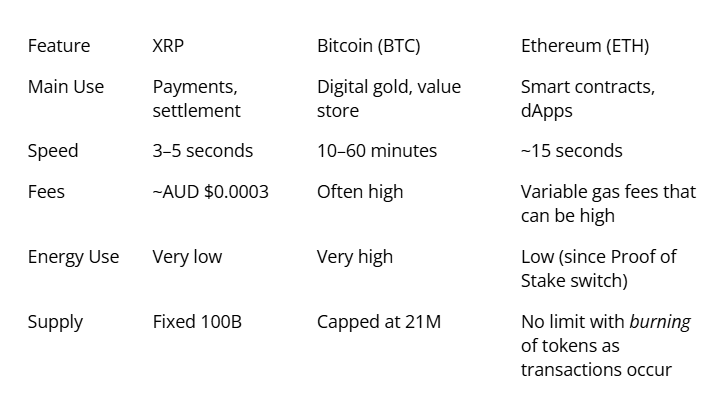
XRP is uniquely optimised for financial transactions. Its consensus model allows it to scale easily, and its environmental impact is minimal compared to Bitcoin's mining operations. Ethereum has more programmability but is often slower and more expensive for transactions.
How to buy XRP through BTC Markets
Getting started with XRP on BTC Markets is easy. Here’s how:
Step 1: Create an account. Head over to BTC Markets and sign up. Complete the KYC verification by submitting your ID and personal details.
Step 2: Fund your account. Deposit AUD via bank transfer, Payid, or BPAY. Deposits are typically processed quickly, and no fees are associated with AUD deposits.
Step 3: Buy XRP. Select the XRP/AUD trading pair and choose your order type:
- Market Order: Buy instantly at the current market price.
- Limit Order: Set a specific price you want to pay.
Once confirmed, XRP will be deposited into your BTC Markets wallet.
How to sell your XRP through BTC Markets
Selling XRP is just as simple as buying it:
1. Log in to your account.
2. Choose the XRP trading pair (e.g., XRP/AUD).
3. Select market or limit order.
4. Enter the amount to sell and confirm.
5. Funds will be credited to your account and can be withdrawn to your nominated bank.
Storing XRP safely
- You have two main options for storing XRP: custodial (on-exchange) and non-custodial (in your own personal cryptocurrency wallet).
- Hot wallets are online storage solutions and include mobile apps, browser extensions, and desktop software. They’re convenient for everyday use but are vulnerable to online threats.
- Cold wallets are offline storage solutions such as hardware wallets (like Ledger or Trezor) or paper wallets. These are ideal for long-term storage as they minimise exposure to hackers.
BTC Markets secures funds in cold storage with additional protections like two-factor authentication (2FA), encryption, and regular audits. If you’re handling large amounts, consider transferring your XRP to a cold wallet for enhanced safety.
The future of XRP in 2025 and beyond
As we look to the future, XRP is well-positioned to play a bigger role in global finance. Its speed, scalability, and energy efficiency make it an appealing infrastructure layer for modern financial systems.
Here are a few trends to watch:
- Institutional adoption of On-Demand Liquidity is growing as banks modernise their cross-border payment systems.
- CBDC pilots using the XRP Ledger could lay the groundwork for XRP’s deeper integration into national digital currencies.
- Retail and developer interest is on the rise as education improves and new features, such as tokenisation and decentralised finance (DeFi), are added to the XRP ecosystem.
Despite challenges from regulators and competitors, XRP has the backing of a strong community, a global network of institutional partners, and a clear use case in bridging the world’s currencies.
Whether you're interested in fast, low-cost payments or diversifying your crypto portfolio, XRP remains a compelling option in 2025 and beyond.
Buy XRP with BTC Markets
Whether you're looking to diversify your crypto portfolio or explore fast, global payments, XRP offers a compelling opportunity. BTC Markets offers a regulated and secure, Australian-based platform for buying, selling, and storing XRP with ease.
Get BTC Markets content delivered
Keep up to date with the latest from BTC Markets. Unsubscribe anytime.SubscribeFind out the latest crypto news