![[object Object]](https://cdn.sanity.io/images/yz4v1m0i/production/38f2c02224d5ea8d551881949e819f95a9952e46-3972x5243.jpg?rect=0,0,3972,3972&w=48&h=48&fm=webp&fit=min)


Google reviews
"I've been using BTC Markets for all my crypto trades and couldn't recommend them more highly. Simple UI/UX and professional support.” – Steve, 5-star review
If you've had a great experience with BTC Markets, we'd love to hear from you! Leave us a review on Google today.
Introduction
The week of 30 April to 7 May 2026 delivered one of the most consequential seven-day stretches for institutional crypto adoption in 2026. Bitcoin climbed from a tentative hold above US$75,000 to a weekly high of A$114,198 / US$82,800, geopolitical de-escalation provided a macro tailwind, and the infrastructure underpinning institutional access expanded on multiple fronts. Here are the ten stories that defined the week.
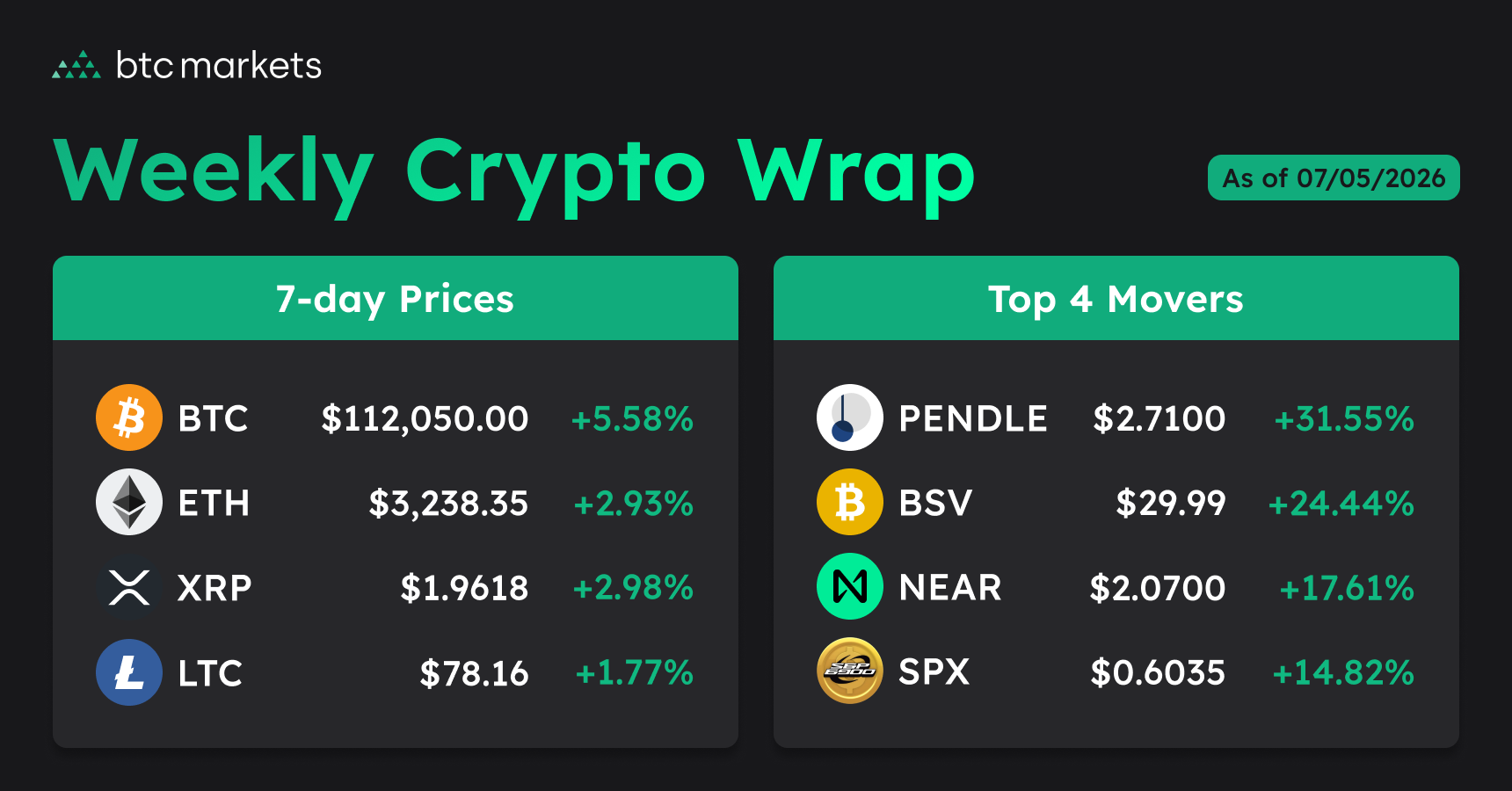
Check prices on the BTC Markets exchange.
State of crypto
- Bitcoin surges to A$114,198 / US$82,800 on US-Iran peace talks and short liquidations
- US spot Bitcoin ETFs record US$1.63B in May inflows, AUM hits US$109B
- CME Group to launch Bitcoin Volatility Futures on 1 June
- Morgan Stanley rolls out crypto trading for Bitcoin, Ethereum and Solana
- Strategy may sell Bitcoin to fund US$1.5B annual dividend obligations
- Solana and Google Cloud launch Pay.sh for AI agent payments
- CLARITY Act faces two-week deadline or passage odds collapse
- US spot Bitcoin ETFs post their strongest month of 2026
- BlackRock’s IBIT records US$335.5M single-session inflow on 4 May
- RBA lifts rates as the US Fed holds rates at 3.50-3.75%
Seven days. Ten stories. One clear theme: institutional capital is not stepping back from crypto; it is stepping in deeper.
The week of 30 April to 7 May opened with the Federal Reserve holding rates steady for the third consecutive meeting, a macro signal that initially weighed on risk assets. Bitcoin dipped below A$106,000 / US$75,000 before recovering sharply as geopolitical news shifted the narrative. US-Iran peace talks triggered a broad risk-on move, US$200 million in short liquidations, and a push to A$114,198 / A$114,198 / US$82,800. At the same time, the infrastructure story was building quietly: CME announced volatility futures, Morgan Stanley launched crypto trading, and the CLARITY Act entered a critical legislative window.
Zooming out, April closed as the strongest month for US spot Bitcoin ETF inflows in all of 2026, with US$1.97B recorded across the month. By week’s end, total ETF AUM reached US$109B. The structural story has not changed. What has changed is its scale.
Bitcoin surges to A$114,198 / US$82,800 on US-Iran peace optimism
The dominant price story of the week had its roots in geopolitics. President Trump announced progress in US-Iran negotiations, citing the potential for a memorandum of understanding that could reopen the Strait of Hormuz and ease energy sanctions. Oil prices fell sharply in response, with WTI dropping to US$88/barrel, a move that freed up risk appetite across global markets.
Bitcoin responded directly, rallying from a hold near US$75,000 to a weekly high of A$114,198 on the BTC Markets exchange (US$82,800). The move triggered more than US$200 million in short liquidations across perpetual futures markets, accelerating the upside leg and briefly pushing the total crypto market capitalisation higher by tens of billions of dollars. Ethereum gained alongside BTC, and broader risk assets followed. The rally demonstrated that Bitcoin continues to respond to the same macro variables that move equities and commodities, while developing its own structural demand from institutional buyers that makes those moves increasingly durable.
Key level established: US$80,000 as near-term support on any pullback. US$83,500 and US$85,000 remain the immediate resistance zones to watch.
Check BTC
US spot Bitcoin ETFs record US$1.63B in May inflows, AUM hits US$109B
In the same week Bitcoin printed a local high, US spot Bitcoin ETFs delivered two consecutive days of near-record demand. Monday’s session recorded US$532 million in net inflows. Tuesday added US$467 million. Combined, the two-day total of US$999 million pushed May’s running inflow total to US$1.63B by week’s end and lifted total AUM across all US spot Bitcoin ETF products to US$109 billion, the highest level recorded in 2026.
BlackRock’s iShares Bitcoin Trust led with US$335.5 million across those sessions, followed by Fidelity’s FBTC at US$184.6 million. The magnitude of these flows is worth placing in context: institutional buyers are now absorbing multiples of daily mined Bitcoin supply across ETF products alone, before accounting for OTC accumulation, corporate treasury purchases, or exchange demand. This is not a speculative trade. It is a structural shift in how large pools of capital are gaining exposure to Bitcoin.
CME Group announces Bitcoin Volatility Futures for 1 June launch
CME Group confirmed it will launch Bitcoin Volatility Futures on 1 June 2026, pending regulatory review. The contracts track CME’s Bitcoin Volatility Index, known as BVX, and settle in cash, allowing institutional traders to gain exposure to Bitcoin’s implied volatility without taking directional price positions.
This is a meaningful expansion of the institutional crypto toolkit. Volatility products allow sophisticated market participants to hedge portfolio risk, express views on market uncertainty, and manage options books with greater precision. For a market that has historically lacked these instruments, the CME’s move reflects both the maturity of Bitcoin’s derivatives ecosystem and the growing demand from institutional desks for professional-grade risk management tools. The launch also adds to CME’s already substantial Bitcoin product suite, which includes futures and micro futures that have become key benchmarks for global price discovery.
Morgan Stanley launches crypto trading
Morgan Stanley has begun rolling out cryptocurrency trading on its platform, offering Bitcoin, Ethereum, and Solana to its 8.6 million clients. When combined with Morgan Stanley’s MSBT Bitcoin ETF, which launched in April at an industry-low management fee of 0.14%, the picture is of a major traditional financial institution deploying a deliberate, multi-product strategy to capture retail crypto market share. This is not a token gesture. With 8.6 million clients gaining direct access to spot crypto alongside an institution-grade ETF option, Morgan Stanley is positioning itself as a full-service crypto gateway for mainstream investors. For the broader market, competitive fee pressure across the largest platforms has historically benefited retail investors through lower transaction costs.
Check XRP
Strategy signals possible Bitcoin sales to fund dividend obligations
Strategy, the company formerly known as MicroStrategy and the world’s largest corporate Bitcoin holder, revealed it may sell a portion of its Bitcoin holdings to fund its US$1.5 billion annual dividend obligations. The disclosure marks a significant shift from the company’s longstanding ‘never sell’ posture, which had become a defining feature of its identity in the market.
Executive Chairman Michael Saylor framed the move as strategic balance sheet management rather than a retreat from Bitcoin. The company holds 818,334 BTC, valued at approximately US$66.7 billion at current prices, against a reported Q1 unrealised loss of US$12.54 billion due to Bitcoin’s earlier price weakness. The announcement attracted significant attention because Strategy’s treasury approach has been widely studied and replicated by other corporate treasury programmes globally. How the company navigates the balance between holding Bitcoin and meeting dividend obligations could influence how other corporate treasuries with similar mandates structure their positions.
Solana and Google Cloud launch Pay.sh for AI agent payments
The Solana Foundation and Google Cloud jointly launched Pay.sh, a platform that enables artificial intelligence agents to pay for API services using stablecoins on the Solana blockchain. The platform supports more than 75 APIs at launch, including Google Cloud services such as Gemini, BigQuery, and Vertex AI, with micropayments processed in fractions of a cent.
The practical significance of this development is structural rather than speculative. As AI agents become increasingly capable of performing autonomous tasks, web research, data processing, code execution, the ability to programmatically pay for computational resources becomes a meaningful requirement. Stablecoins on Solana offer settlement speed and transaction costs that make micropayment workflows viable at scale. This positions Solana not just as a consumer or institutional blockchain but as payment infrastructure for machine-to-machine commerce. That use case, if it scales with the growth of agentic AI, could drive sustained on-chain activity and SOL demand that is independent of speculative trading cycles.
Check ETH
CLARITY Act enters a critical two-week legislative window
Ripple CEO Brad Garlinghouse issued a pointed warning this week: the CLARITY Act has approximately two weeks to advance through the US Senate before the approaching midterm election cycle dramatically reduces its passage odds. Garlinghouse described the risk of decline as ‘precipitous’ if momentum stalls.
The bill, which aims to divide oversight of digital assets between the SEC and CFTC and establish a federal market structure framework for crypto, cleared one significant hurdle this week. A bipartisan compromise between Senators Tillis and Alsobrooks resolved a sticking point around stablecoin yield provisions. However, ethics specifications targeting President Trump’s own crypto interests remain contentious and unresolved. The outcome of this bill matters not just for US market participants but for the global regulatory posture toward digital assets. A coherent federal framework would provide the legal clarity that institutional capital has long cited as a prerequisite for broader allocation.
Check XRP
April closes as the strongest Bitcoin ETF month of 2026
Before the week had even concluded, April had already delivered a landmark data point. US spot Bitcoin ETFs recorded US$1.97 billion in net inflows across the month, the strongest monthly figure of 2026 and nearly double the total recorded in March. BlackRock’s IBIT accounted for most of those flows, including a single-session record of US$629.8 million on 1 May, as institutional positioningahead of May’santicipated liquidity conditions drove outsized demand.
Ethereum ETF products also recorded a constructive April, with US$355 million in inflows. The monthly totals reflect a market where institutional demand is not merely present but accelerating. As ETF AUM approaches and then exceeds US$109 billion, the Bitcoin ETF complex is becoming a meaningful force in global fixed-income and equity portfolio allocation conversations. That structural demand dynamic is increasingly difficult to separate from Bitcoin’s price behaviour.
BlackRock’s IBIT records a US$335.5M single-session inflow
Within the broader ETF inflow story, BlackRock’s iShares Bitcoin Trust posted a standout individual session during the week, recording US$335.5 million in net inflows in a single day. That figure represents one of the largest single-session IBIT inflows recorded since the ETF launched in January 2024.
Fidelity’s FBTC followed with US$184.6 million across the same sessions. The concentration of flows into the two largest products reflects both the institutional preference for established deeply liquid vehicles and the role that fee competition has played in consolidating AUM. BlackRock’s distribution network, its established brand with institutional allocators, and IBIT’s liquidity profile make it the default vehicle for large mandates entering the space. For retail investors on platforms like BTC Markets, the direction of IBIT flows remains one of the most reliable real-time signals of institutional sentiment.
RBA lifts rates as the US Fed holds rates at 3.50-3.75% for a 3rd consecutive meeting
The US Federal Reserve held its benchmark rate at 3.50-3.75% for the third consecutive meeting, drawing four dissenting votes, the most internal division since 1992. Locally, the RBA raised its cash rate to 4.35%, with strategists warning rates could reach 5% or beyond. The RBA shadow board is pencilling in a peak of 5.35%, with core inflation not expected to return to target until 2028. The common thread is energy, with oil prices elevated by Iran conflict tensions feeding directly into inflation in both economies.
Check SOL
Crypto Fear & Greed Index
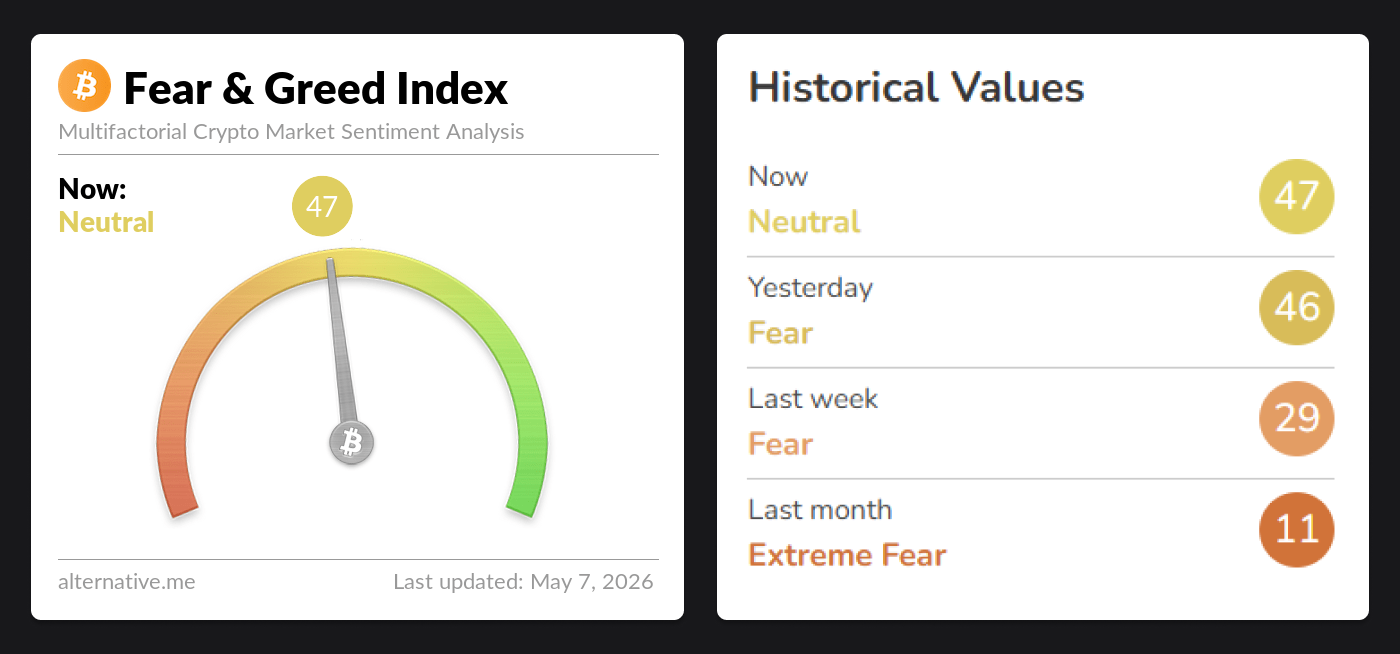
Source: Fear & Greed Index
Announcements

BTC Markets named finalist at the Finnies 2026
We’re proud to share that BTC Markets has been named a finalist for Best Workplace Diversity at the Finnies 2026 by FinTech Australia. Congratulations to Anastasia Varlamova, our People and Culture Manager, who is shortlisted for Emerging Fintech Leader of the Year (Under 35).

Caroline Bowler to speak at SIAA 2026
We’re pleased to share that Caroline Bowler, Non-Executive Director at BTC Markets, will be speaking at the Stockbrokers and Investment Advisers Association 2026 Investment Advisers Association on 19-20 May 2026 at the Park Hyatt Melbourne.
The conference brings together industry professionals to examine how the foundations of investment are being shaped by pressures on global trade and cap
The week ahead: Economic events
Thursday, May 7th
- Australia Balance of Trade
Friday, May 8th
- Germany Balance of Trade
- Canada Unemployment Rate
- United States Non Farm Payrolls, Unemployment Rate, Michigan Consumer Sentiment
Saturday, May 9th
- China Balance of Trade, Exports YoY, Imports YoY
Monday, May 11th
- China Inflation Rate
- United States Existing Home Sales
Tuesday, May 12th
- Australia Consumer Confidence MoM, Business Confidence
- Germany ZEW Economic Sentiment Index
- United States Core Inflation Rate MoM, Inflation Rate MoM, Inflation Rate
Wednesday, May 13th
- United States Producer Price Inflation MoM
Source: Trading Economics
Market reflections
- United States: Labour market data sharpens focus on Fed policy path
- Europe: European investment banks struggle to keep pace with US rivals
- China: Manufacturing activity holds steady as geopolitical risks rise
- Japan: Yen volatility increases as intervention concerns return
- Australia: RBA raises rates for the third time in 2026
In the United States, attention has shifted back to labour market data as investors reassess the likelihood of rate cuts this year. Stronger employment figures and persistent wage pressures continue to narrow the Federal Reserve’s room to ease policy. Markets are now pricing in a higher-for-longer rate environment, which has weighed on broader risk appetite and contributed to more cautious positioning across digital assets.
Across Europe, investment banks are struggling to keep pace with their US rivals as dealmaking, and capital markets activity remain uneven. Slower growth, weaker investment banking revenues, and tighter market conditions continue to pressure European financial institutions. The divergence highlights how capital and liquidity remain concentrated within larger US firms, reinforcing broader concerns around competitiveness and market confidence across the European financial sector.
In China, factory activity remained in expansion territory despite rising geopolitical tensions linked to developments in the Middle East. Manufacturing resilience suggests domestic stimulus measures are continuing to support industrial output, although uncertainty around energy markets and trade flows remains elevated. Commodity prices and supply chain concerns are likely to stay closely tied to geopolitical developments in the weeks ahead.
In Japan, authorities reportedly stepped into currency markets for the first time in two years to support the yen following a sharp depreciation. The move reflects growing concern around exchange rate volatility as the interest rate gap between Japan and other major economies remains wide. Currency intervention risks are now back in focus, particularly as markets continue to test the Bank of Japan’s policy stance.
In Australia, the Reserve Bank raised the cash rate to 4.35% this week, its third increase of the year, as policymakers continued their efforts to bring inflation back under control. Bond managers and rate strategists have warned the tightening cycle may not be finished, with some forecasting the cash rate could reach 5% or above before the RBA is satisfied that inflation is on a credible path back to its 2.5% target. The RBA's own forecasts do not have price growth returning to target until 2028, a timeline many in the market consider optimistic given elevated oil prices, the upcoming federal budget, and a minimum wage decision affecting a quarter of the workforce.
For Australian crypto investors, the rate environment has practical implications. A higher cash rate increases the relative appeal of lower-risk, yield-bearing assets, raising the threshold for capital to flow into higher-volatility markets. A strengthening AUD, driven by RBA tightening while the Fed holds steady, also means that US dollar-denominated crypto prices translate to softer returns in local currency terms. Currency moves can work for or against Australian holders independently of what digital asset prices are doing in global markets, and that dynamic becomes more pronounced during periods of central bank divergence.
Final thoughts
The week of 30 April to 7 May did not produce a definitive breakout or a dramatic market reversal. What it produced was something arguably more meaningful: a sustained accumulation of evidence that institutional engagement with crypto is deepening across product types, distribution channels, and regulatory frameworks simultaneously.
Bitcoin’s push to A$114,198 / US$82,800 was headline news, but the more durable story is US$109B sitting in ETF products, CME building out volatility infrastructure, Morgan Stanley competing on fees for retail crypto access, and Solana positioning itself as payment rail for autonomous AI agents. These are not speculative narratives. They are observable structural developments.
Looking ahead, the key variables to monitor are the CLARITY Act’s legislative progress over the next two weeks, Bitcoin’s ability to hold US$80,000 as support through any macro-driven volatility, and the trajectory of monthly ETF inflows as May develops. US$85,000 remains the next meaningful resistance level for Bitcoin. A clean break and close above that zone would represent a structural shift worth watching closely.
The macro environment remains complex. The institutional build-out does not.
Ready to take advantage of the opportunities shaping the market?
Log in to trade on Australia’s own digital asset exchange and stay positioned for what comes next.

Online safety: Fraudsters are impersonating trusted institutions
Scammers are increasingly posing as financial institutions, crypto wallet providers, and law enforcement agencies to pressure Australians into transferring funds or revealing sensitive account information. Many of these scams rely on personal data exposed through previous breaches, making the contact appear legitimate.
In one reported case, a victim received an email claiming their details had been exposed in a data breach. They were later contacted by someone pretending to represent their crypto wallet provider, who referenced genuine purchase details to build trust. The victim was instructed to urgently “secure” their wallet by updating their seed phrase. Shortly after, more than A$350,000 in digital assets was stolen.
As the Australian Federal Police warned, scammers often approach victims “armed and ready” with personal information obtained through past cyber incidents. These tactics are designed to create panic and urgency, particularly around account security and fund safety.
What to watch out for
- Unsolicited calls, emails, or messages claiming your wallet or account is compromised
- Requests to share passwords, 2FA codes, or seed phrases
- Pressure to act urgently or move funds for “security reasons”
- Requests to install remote access software on your device
- Links or contact numbers provided directly by the caller or sender
BTC Markets will never:
- Request your passwords, 2FA codes, or seed phrases over phone or email
- Ask for remote access to your device or request software installation
- Instruct you to transfer funds to another platform or third party for “protection”
- Ask you to verify or reset your seed phrase
Anyone requesting access to your seed phrase is attempting to steal your assets.
If you receive suspicious contact
- Stop and do not share account details or transfer funds
- End the call or conversation immediately
- Verify independently through official BTC Markets support channels
- Report the incident to Scamwatch, ReportCyber, and BTC Markets
Protect yourself and stay informed:
Stay up to date on the latest news in the crypto space.
Sign up for free and join over 380,000 Australian traders who receive the BTC Markets Weekly Crypto Wrap.
Subscribe to our status page for live system updates or follow us on X.
Feedback
If you have any feedback on our newsletter or want to request specific content, please submit a support ticket and we will respond shortly.
Disclaimer: The information provided on this page is issued by BTC Markets Pty Ltd (BTC Markets, we, us, our). The information is general only and is not intended to constitute an opinion or recommendation with respect to its contents. Past performance is not a reliable indicator of future performance. Any reference to past performance is intended to be for general illustrative purposes only. The information cannot be relied upon for any purposes and is not intended to be a substitute for professional advice.
The information does not purport to be complete, accurate or contain all of the information that a person may require to make a decision. It may also contain forward looking statements, which are subject to known and unknown risks, uncertainties, and other factors. We recommend you obtain professional advice before making any decision with respect to the matters discussed in this document. To the maximum extent permitted by law, BTC Markets will have no liability for any loss or liability of any kind: (i) arising in respect of the information contained (or not contained) on this page; or (ii) arising from a person relying on any information or statement contained on this page. The information provided is only intended for recipients in Australia. This information cannot be reproduced without our prior written permission.
Get BTC Markets content delivered
Keep up to date with the latest from BTC Markets. Unsubscribe anytime.SubscribeFind out the latest crypto news

What institutional partners should take from Australia's tokenisation timeline